ACT Reading Section: Speed and Accuracy Tips That Actually Work
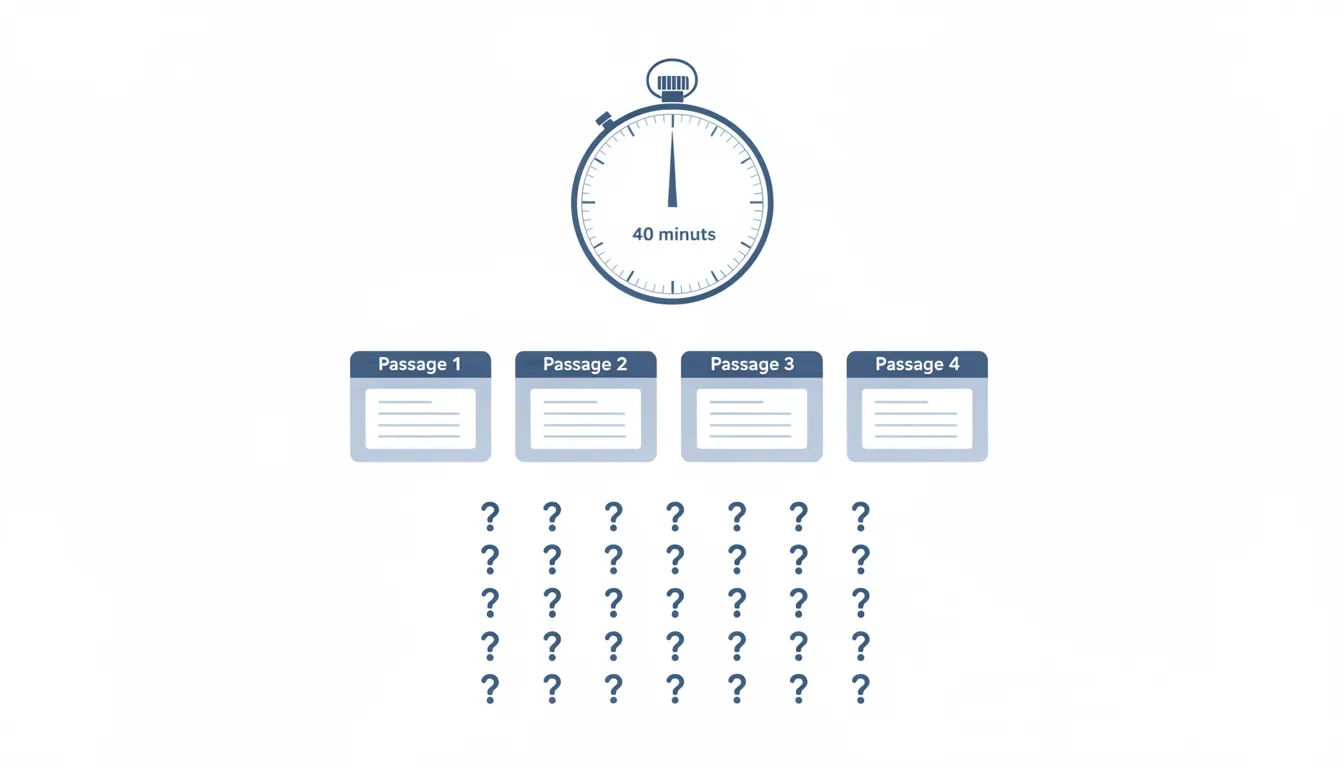
The ACT Reading section gives you roughly 67 seconds per question. That's the math: 40 minutes, 36 questions, four passages. Most students panic at that number and decide the fix is to read faster. But the students who actually move their scores from a 24 to a 30 usually aren't reading faster. They're reading differently. They've stopped trying to absorb every word and started thinking like a test-maker — and those are very different skills.
The Uncomfortable Math of the ACT Reading Section
The format is fixed: four passages, each with 9 questions (one of those passages is a "dual passage" pairing two shorter texts). You have 40 minutes total. That's about 8.5 minutes per passage, which leaves very little margin for re-reading or second-guessing.
Here's a realistic time breakdown per passage if you're targeting a competitive score:
- Reading and annotating: 3 minutes
- Answering 9 questions: 5–6 minutes
- Bubbling answers (do this after each passage, not at the end): 30 seconds
The most common timing mistake: students read slowly and carefully, then sprint through questions. That reverses the priority completely. The questions are where points happen. Fast-ish reading, deliberate answering — not the reverse.
A subtler issue: many students think timing is their problem when it's actually accuracy. If you're finishing with 3 minutes to spare but scoring a 22, time management isn't what needs fixing.
Choosing Your Reading Approach
There is no single universally correct way to attack an ACT passage. Three different strategies work for three different types of readers, and the worst thing you can do is switch approaches mid-test because a friend swears by a different method.
| Approach | How It Works | Best For |
|---|---|---|
| Full passage first | Read everything, then answer all questions | Fast readers who retain detail under pressure |
| Questions first | Skim questions for key terms, then read passage | Students who know exactly what they're hunting for |
| Skim + locate | Read intro, conclusion, and topic sentences; find evidence per question | Students who consistently run out of time |
Both PrepScholar and PrepMaven make the same point: familiarity with ACT question formats matters more than raw reading speed. A slower reader who knows the test's patterns will outperform a fast reader who doesn't.
My take: the "skim + locate" approach is underrated for most students aiming for the 27–31 range. Reading every word of a 900-word passage on 19th-century cartography is not a good use of 3 minutes. Identify the structure, then locate evidence as questions demand it.
Commit to one approach before test day. Practice it until it's automatic, then measure your accuracy rate. That's your feedback loop.
What to Actually Annotate (and What to Skip)
"Active reading" is one of those phrases that gets thrown around in test prep without much guidance on what it actually means in practice. Vague annotation can easily cost more time than it saves.
Mark these things as you read:
- The main point of each paragraph (a one-word or short phrase label in the margin)
- Transition words that signal a shift: "however," "yet," "despite," "in contrast"
- Any point where the author's tone or opinion becomes explicit
- Specific names, dates, or numbers — you'll need to find these fast later
Skip these:
- Interesting-but-irrelevant details (anything that won't appear in a question)
- Full sentences or long underlined passages
- Everything that confirms information you already know from context
PrepMaven calls this building a "passage map," and that framing is right. You're not studying the passage. You're constructing a fast-retrieval system for the 5 minutes of answering that follows.
The most common annotation mistake: students spend 5 full minutes reading and marking, then run out of time on questions. The annotation exists to speed up the question phase, not to replace it. If your notes are comprehensive enough to grade as a book report, they're too long.
The Four Passage Types (and the Trap in the First One)
The ACT Reading section always runs in the same order: Literary Narrative (fiction or memoir), Social Science, Humanities, Natural Science. Knowing this structure lets you prepare specific mental gears for each type before the test starts.
PrepMaven flags a sharp counter-intuitive point: the Literary Narrative looks approachable because it's a story. But it typically contains some of the most time-consuming questions on the section — character motivation, implied tone, subtle inference. Students rush in, get stuck hunting for a feeling described in paragraph seven, and start passage two already two minutes behind schedule.
Treat the Literary Narrative with respect. Practice it separately before mixing it with other passage types.
Every question on the ACT is worth exactly one point. The right order to tackle passages isn't the ACT's order — it's yours. Do your strongest passage type first and save the hardest for last.
If you consistently find Natural Science easiest and Literary Narrative hardest, flip them. Nothing in the rules prevents it.
Recognizing Wrong Answers Before They Trick You
Accuracy on ACT Reading isn't purely about understanding the passage. A big chunk of it is pattern recognition on answer choices. Wrong answers follow predictable templates, and once you've seen enough of them, the traps become obvious.
The four main wrong answer types:
- Extreme language — answers using "always," "never," "only," or "all" are almost always wrong. The ACT favors qualified, moderate claims.
- Detail scrambles — real words from the passage assembled into a claim the passage never actually made. These feel right because they sound familiar.
- Too broad or too narrow — the answer either over-generalizes from a single paragraph or zooms in on a minor detail that doesn't answer the actual question.
- Outside logic — something that makes intuitive sense in the real world but isn't explicitly supported by this specific text.
The single highest-leverage accuracy habit: predict your answer before reading the choices. Generate a rough answer directly from the passage, then eliminate choices that don't match. This prevents "shiny" wrong answers from hooking you — they sound plausible until you check them against a prediction you already made.
Students who read choices and wait to feel a click of recognition are playing on the test-maker's turf. Students who predict first are playing on their own.
Pacing: Checkpoints and the Never-More-Than-10 Rule
Watching the clock while you read is counterproductive. It spikes anxiety and breaks your comprehension. Instead, use a checkpoint system — check your time only after you finish each passage.
Target times to stay on pace:
- After passage 1: under 9 minutes elapsed
- After passage 2: under 18 minutes elapsed
- After passage 3: under 27 minutes elapsed
- Passage 4: use whatever time remains
If you finish passage 2 at 20 minutes, you're two minutes behind. The adjustment isn't panic — it's one specific behavior change. In the next passage, read only the first sentence of each paragraph instead of the full paragraph. You'll sacrifice some comprehension but stay in the game.
The never-more-than-10 rule: no single passage should consume more than 10 minutes of your time. If you're at minute 9 on passage 3 with three questions unanswered, guess and move on. A 75% completion rate across four passages consistently beats a 100% completion rate across three.
The College Panda's guide recommends a small but effective tactic: circle your answer in the test booklet first, then transfer all 9 to the answer sheet after completing the passage. Done passage by passage rather than question by question, this saves approximately 90 seconds that students typically lose searching for the correct bubble row mid-passage. Small, but real.
Handling the Dual Passage
One of the four passages is always a dual passage — two shorter texts on a related topic, often with contrasting perspectives. Students regularly make the mistake of trying to hold both texts in mind simultaneously before answering anything.
Don't. Treat the dual passage as two completely separate mini-passages.
Read Passage A. Answer every question that refers only to Passage A. Then read Passage B. Answer its standalone questions. Handle the comparative questions last — by then, you've already processed both texts individually, so questions about disagreement or difference become significantly easier.
The comparison questions typically ask about tone, purpose, or the point of disagreement between authors. These are higher-order and take more time than simple detail retrieval. If you're running short on time, these are reasonable candidates for a quick strategic guess, which protects clock time for the easier locate-in-text questions that have clearer answers.
One thing that surprises students: the dual passage isn't always harder than a single long passage. The individual texts are shorter. The questions can actually be more direct. Practice it enough and it starts to feel like a break.
No Guessing Penalty — So Stop Leaving Blanks
The ACT has no wrong-answer penalty. A blank and a wrong answer both score zero. A lucky guess scores one. This means leaving any question blank is a strictly worse outcome than guessing, in every situation.
If you have 90 seconds left and four questions unanswered, pick a single letter and mark it for all four without deliberating. Cycling through the same reasoning you already tried won't produce a better answer. PrepScholar notes that students aiming for a 25 can deliberately skip 10–12 harder questions during the section, spend more focused time on the rest, and still hit their target score.
This reframes how you should categorize difficult questions. They're not roadblocks. They're optional. Skip them early, bank time for questions you can answer confidently, and return only if time permits.
The students who lose points on this section aren't just the ones who don't know the answers. They're also the ones who know the answers but ran out of clock while wrestling with questions they should have guessed and moved past.
Building Real Speed Through Structured Practice
The honest truth about ACT Reading speed: you cannot sprint your way to a 34. But you can build reliable pace through structured, sequenced practice.
The College Panda recommends a three-phase method that's more systematic than just "doing practice tests":
- Baseline phase — time yourself on individual passages and note exactly where time disappears: during reading, during questions, or both
- Isolation phase — practice single passages under timed conditions until you're consistently finishing at 8.5 minutes
- Full-section phase — run complete 40-minute reading sections with checkpoint timing, simulating real test conditions
Magoosh's pacing guide shares an instructive case of a student named Marion who actually improved her score by deliberately slowing down on three passages and taking better notes — sacrificing completion on one passage to protect accuracy on the others. That counterintuitive move went against every instinct she had. It worked.
Speed is a byproduct of familiarity. After doing enough Social Science and Humanities passages, you stop processing every sentence consciously. The cognitive load drops and your natural pace increases, without any deliberate effort to rush.
Bottom Line
- Spend 3 minutes reading, 5–6 minutes answering. Protect question time above reading time.
- Build a passage map, not a transcript. Mark transitions, author opinion, and key specifics only — nothing else.
- Use checkpoint timing after each passage rather than watching the clock while you read.
- Predict your answer before reading choices. This single habit eliminates more wrong answers than any other technique.
- Never leave a blank. Guess a letter and move on when time runs short.
The goal isn't to read faster. It's to waste less time on the wrong things — and that's entirely within your control.
Frequently Asked Questions
How many minutes should I spend per passage on the ACT Reading section?
Target 8 to 8.5 minutes per passage. That breaks into roughly 3 minutes for reading and annotation and 5–6 minutes for the 9 questions. Use checkpoint timing after completing each passage (9 minutes, 18 minutes, 27 minutes elapsed) rather than checking the clock continuously while you read — that approach creates anxiety without improving pace.
Is it better to read the questions first or read the passage first?
It depends on how you process text under pressure. Reading questions first works well for detail-oriented students who know what terms to hunt for. For most students, though, skimming the passage for structure first (intro, conclusion, topic sentences, transitions) and then predicting answers from the text produces better accuracy. The universal rule: predict your answer before reading the four choices, regardless of which approach you use.
Is the Literary Narrative passage easier than the others?
This is one of the most persistent misconceptions in ACT prep. The Literary Narrative passage (always first) looks friendlier because it's a story, but it typically contains the section's most time-consuming questions — implied tone, character motivation, subtle inference. Many students find Natural Science or Social Science passages more manageable because the structure is logical and questions tend to be more direct. Don't assume order equals difficulty.
What makes an answer choice wrong on ACT Reading?
Wrong answers follow four reliable patterns: extreme language ("always," "never," "only"), detail scrambles (real words from the passage assembled into false claims), answers that are too broad or too narrow for the specific question asked, and outside logic that seems reasonable but isn't supported by the text. Recognizing these patterns speeds up elimination and reduces the time you spend second-guessing choices that were never correct.
How much practice do I actually need to see real timing improvement?
The College Panda author reported needing more than 8 full practice tests before consistent timing felt automatic. That's on the higher end, but the principle holds: isolated passage drills help you identify where time disappears, but full-section practice builds the stamina and intuitive pacing judgment that the real test requires. Aim for at least 4–6 complete Reading sections under real conditions (timed, no distractions, starting after simulated English and Math sections) before test day.
Does reading faster actually help?
At the margins, yes. But reading speed is rarely the core problem. Most timing issues come from re-reading passages unnecessarily, lingering too long on hard questions, or weak question-answering strategy — not slow word recognition. Fix strategy first. If timing is still a problem after internalizing the techniques above, then targeted speed drills make sense as a follow-up intervention, not the starting point.