How AI Is Changing Financial Aid Applications: What You Need to Know
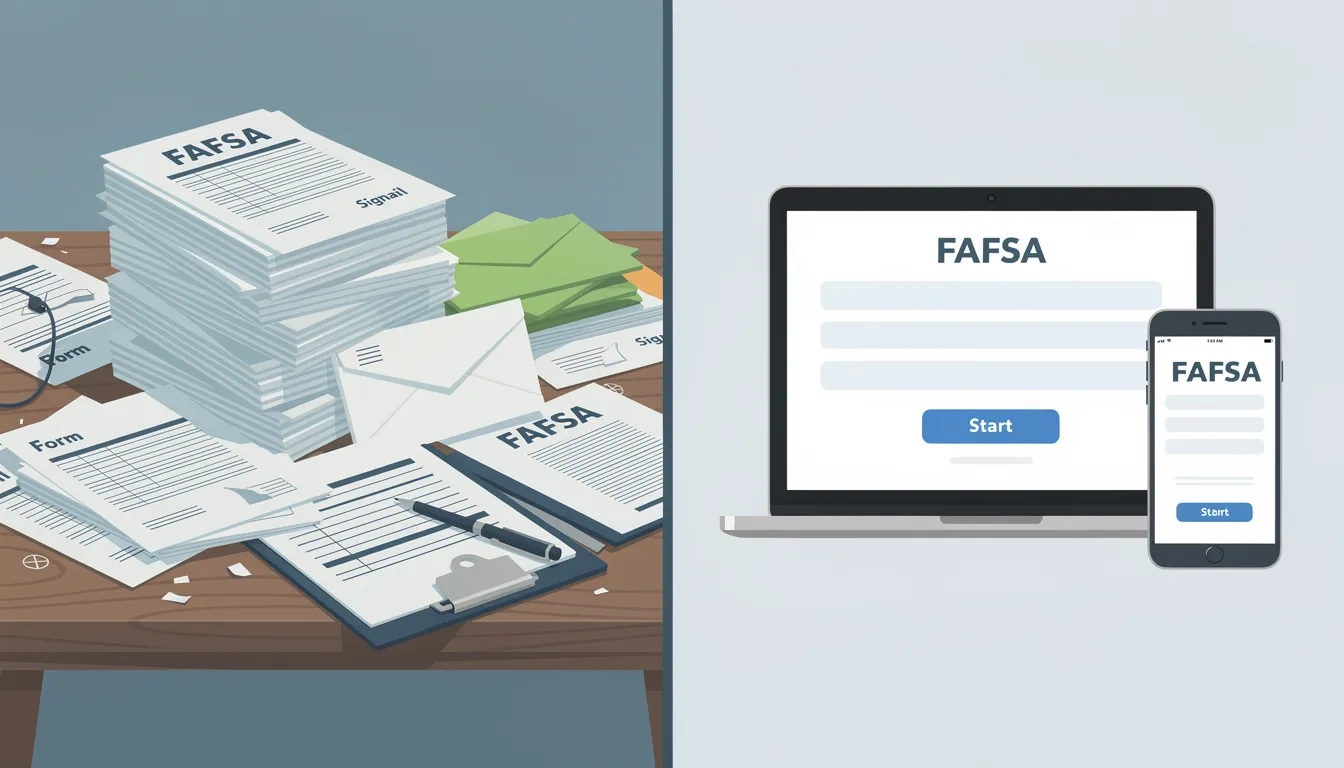
When the redesigned FAFSA opened for 2024-25 applications, it broke almost immediately. A Government Accountability Office investigation found that three-quarters of calls to the Education Department's help centers went unanswered during the first five months of the rollout. Students waited. Colleges delayed sending aid award letters well into spring. Families made enrollment decisions without knowing what they could actually afford.
That chaos made one thing clear: the financial aid system, built for humans processing forms at human speed, couldn't hold up. And it opened a very wide door for AI.
The FAFSA Changes That Created New Confusion
The 2025-26 FAFSA went live December 1, 2024 with real improvements baked in. Question count dropped from over 100 to roughly 46. Tax data now transfers directly from the IRS. The form expanded from two languages to eleven.
But every simplification created confusion somewhere else. "Expected Family Contribution" became "Student Aid Index." Dependency rules shifted to prioritize financial support over custody. Family farms and small businesses now count differently in the formula. Families who thought they knew the system were suddenly wrong about half of it.
That knowledge gap is where AI entered first. The questions didn't go away — they just moved from the form into interpreting the form. And AI tools were positioned for exactly that kind of high-volume, repetitive explanation work.
AI as the First Stop for Student Questions
Before any student submits anything, they have questions. Usually a lot of them, usually late at night.
Forsyth Technical Community College in North Carolina found that after deploying an AI chatbot for financial aid guidance, the system handled 79% of inquiries without a human, redirecting over 36,600 staff minutes toward cases that genuinely needed an advisor. Enrollment jumped 12% in spring 2023, then another 10% the following spring.
The mechanism is straightforward. Students who can't get an answer at 10pm on a Tuesday often just stop. They come back to the form later — or they don't. AI available around the clock, in the student's language, removes friction that was costing schools real enrollment numbers.
Today's financial aid chatbots cover more than definitions. Element451's Bolt AI Assistant integrates directly with a college's student information system, so a conversation can trigger automatic record updates or flag a student for human follow-up. Schools report handling questions on loan types, school codes, deadline schedules, and full aid package explanations without a human in the loop.
Where these systems fall short is on exception cases: the student with a recently deceased parent, the undocumented applicant, the family whose tax situation doesn't match the standard mold. Bounded questions? AI is fast and reliable. Unusual circumstances? Not the right tool.
Ghost Students and the Fraud Arms Race
While AI was making it easier for real students to apply, criminals were using it to steal.
Financial aid fraud has metastasized since 2020. "Ghost students" — synthetic identities enrolled in online courses to collect federal grants and loans — went from a nuisance to a structural crisis. California's community colleges lost more than $18 million since 2021, with $11 million disappearing in 2024 alone. That same year, 31% of statewide applicants were flagged as fraudulent. Not 3%. Nearly one in three.
Manual review became useless at that scale. A human reviewer scanning one application at a time can't spot that 47 of them share a phone number. AI can.
About 80 of California's 115 community colleges now use Lightleap, a platform built by N2N Services. The system checks behavior at three points: when someone applies, when they register for courses, and when they apply for aid. It draws on device fingerprinting, IP anomalies, shared contact data, age discrepancies, and suspicious registration patterns — connections that only become visible in aggregate.
"When our colleges are looking record by record, they're not seeing the connections or patterns. But AI is really good at finding those things." — Jory Hadsell, California Community Colleges Chancellor's Office
Golden West College reported eliminating 96% of fraud after deploying the tool. But 96% isn't 100%, and the most sophisticated fraudsters keep adapting. California colleges and their detection vendors are in a genuine arms race. The criminals have access to the same AI tools as the defenders, and they keep finding new vulnerabilities.
Personalized Aid Packages: Useful, But Not Neutral
Fraud detection is largely uncontroversial. What AI does to aid packaging is more complicated.
Colleges have always used data to calibrate financial aid offers. What changed is the scale and sophistication of that calculation. Systems like Liaison Othot analyze historical enrollment patterns to forecast how different aid offers influence which students actually show up. A school can model the yield difference between offering a student $3,500 versus $5,500 in grants — across thousands of applicants — before a single letter goes out.
The problem is whose interests the modeling serves. If a student's profile suggests they'll enroll regardless of aid amount, an algorithm might recommend a lower offer. Not because their need is lower. Because the model predicts they don't need the incentive. The school saves budget. The student gets less.
Eric Johnson, Director of Financial Aid at Goldey-Beacom College, flagged a deeper concern in a 2026 essay: AI trained on historical data inherits the patterns of the past, including patterns of inequity. If past enrollment rates were lower among certain demographic groups, the model might systematically recommend less aid to students from those groups. Not malicious — just math doing what math does with biased inputs.
Some platforms have been described as drawing on "social media profiles" alongside financial need and academic history to shape aid recommendations. There are almost no regulatory guardrails on using social data to set grant amounts. That conversation isn't happening at anywhere near the volume it should be.
The DOGE Proposal: AI at Federal Scale
In February 2025, The New York Times reported that Elon Musk's Department of Government Efficiency had proposed replacing the Education Department's financial aid call centers with an AI chatbot.
Those call centers employ 1,625 staff handling more than 15,000 calls daily. They fielded questions from borrowers in active disputes, families confused about Pell Grant eligibility, and students trying to understand repayment plan options. The department had just hired 700 new agents in summer 2024 — because the GAO found most calls were already going unanswered.
Senators Elizabeth Warren, Mazie Hirono, and Chuck Schumer opened a formal investigation into the proposal. Their core concern: generative AI chatbots hallucinate. They produce confident, fluent answers that are factually wrong. In financial aid, a wrong answer about a repayment plan can cost a borrower thousands of dollars. A wrong answer about Pell eligibility might determine whether someone goes to college at all.
The "efficiency" logic doesn't hold up under scrutiny. The 2024 FAFSA rollout already proved the call centers were overwhelmed. Replacing burned-out staff with a system that sometimes invents answers doesn't fix the capacity problem. It repackages it — and transfers the cost onto students.
Where AI Belongs — and Where It Doesn't
The pattern across all these applications is consistent. AI performs well when task volume is high, the question set is defined, and errors are catchable before they cause harm. It breaks down where individual circumstances vary widely and mistakes carry real financial consequences.
| Use Case | AI Fit | Risk Level |
|---|---|---|
| Answering basic FAFSA questions 24/7 | Strong | Low |
| Detecting fraud patterns across thousands of apps | Strong | Medium (false positives exist) |
| Automating document verification | Strong | Low |
| Modeling aid package yield scenarios | Moderate | Medium (bias risk) |
| Replacing advisors for complex individual cases | Weak | High |
| Providing federal loan guidance with legal stakes | Weak | High (hallucination risk) |
For students navigating this right now, a few practical things to know:
- For basic questions, AI chatbots at your school are generally reliable. Use them for deadlines, definitions, and process questions.
- For appeals or unusual circumstances, request a human financial aid officer. Don't take a chatbot answer for anything with real financial stakes.
- If your aid offer seems low, ask the financial aid office directly how your package was calculated — AI-driven yield modeling may have played a role, and you're entitled to that explanation.
- If you're applying to a California community college and get flagged for identity verification, that's likely the fraud detection system. Resolve it proactively; waiting only delays your aid.
My take: the schools handling this well are the ones treating AI as a staff force-multiplier for routine work, not a replacement for human judgment on consequential decisions. That distinction is easy to state and surprisingly hard for budget-pressured institutions to hold.
Bottom Line
AI is genuinely reshaping financial aid — but whether that reshaping helps or harms students depends entirely on where it gets deployed.
- AI chatbots for routine questions: Proven to work. Forsyth Technical's 79% deflection rate and multi-year enrollment gains make the case.
- AI fraud detection: Working well, with room to improve. A 96% fraud elimination rate at Golden West College shows what's achievable.
- AI-driven aid packaging without transparency: A real bias risk that hasn't gotten enough regulatory attention.
- AI replacing human advisors for complex federal aid questions: A false economy. The cost shows up in real harm to real students.
The single most important thing to take away: know when to use AI tools and when to insist on a human. For basic questions, AI is faster and often accurate enough. For anything consequential — an appeal, an unusual family situation, a decision that determines whether you can afford school — a human who can hear your actual circumstances is not optional. It's what the system owes you.
Frequently Asked Questions
Can AI actually help me fill out the FAFSA?
Yes, within limits. AI chatbots at most colleges can explain what each question means, clarify new terminology like "Student Aid Index," and walk through deadline requirements. What they can't reliably do is give personalized advice for complex situations — unusual family structures, recent income changes, or aid appeals. For those, a human advisor is more reliable and worth asking for.
Will AI replace financial aid advisors at my school?
Not entirely, but the role is shifting. At schools using chatbots effectively, advisors spend less time on repeated basic questions and more time on cases that need real judgment. The risk is institutions that treat AI as a headcount reduction tool without accounting for the questions the chatbot can't handle — because those questions still arrive, just with no one available.
Are AI-generated aid packages biased against certain students?
This is a genuine concern backed by how these systems work. When models train on historical enrollment data, they inherit past patterns of inequity. Schools aren't required to disclose whether AI influenced your offer, which makes this hard to verify from the outside. If your package seems inconsistent with your financial need, ask your financial aid office directly how the offer was calculated.
What is a "ghost student" and how does AI catch them?
Ghost students are fake identities — often automated bots — enrolled in online courses to collect federal aid money. AI catches them by spotting aggregate patterns no single reviewer would notice: dozens of applications sharing a phone number, device fingerprints logging in from the same IP across multiple schools, or course registration behavior that looks nothing like a real student. Lightleap, built by N2N Services, uses this approach across three separate application stages.
What happened with the DOGE proposal to replace FAFSA call centers with AI?
As of mid-2026, the proposal was under Senate investigation and had not been implemented. Senators Warren, Schumer, and Hirono opened a formal inquiry in early 2025 over concerns about hallucination risk and data privacy. The Accenture contract running the call centers was under renegotiation, but no chatbot system had been publicly deployed as a replacement.
How do I know if AI influenced my financial aid offer?
Most of the time, you can't tell from the outside — there's no disclosure requirement. What you can do is ask your financial aid office whether any automated yield modeling influenced your package, and request a breakdown of how the offer was calculated. Most offices will answer honestly. If the explanation is unsatisfying, you have the right to appeal, and that process involves a human reviewer.
Sources
- California Colleges Use AI to Battle Financial Aid Fraud — EdSource
- Machine Learning and AI: Transforming the Future of Financial Aid — HEAG
- Artificial Intelligence & Financial Aid Packaging: Are We Crossing an Ethical Boundary? — Goldey-Beacom College
- Education Department Mulls Using AI Chat Bot for FAFSA Help — Inside Higher Ed
- How AI Can Simplify the FAFSA 2025-2026 Changes — Element451
- Transforming Higher Education Financial Aid Through Automation — Campus Technology