Best Colleges for Nursing 2026: Beyond the Rankings
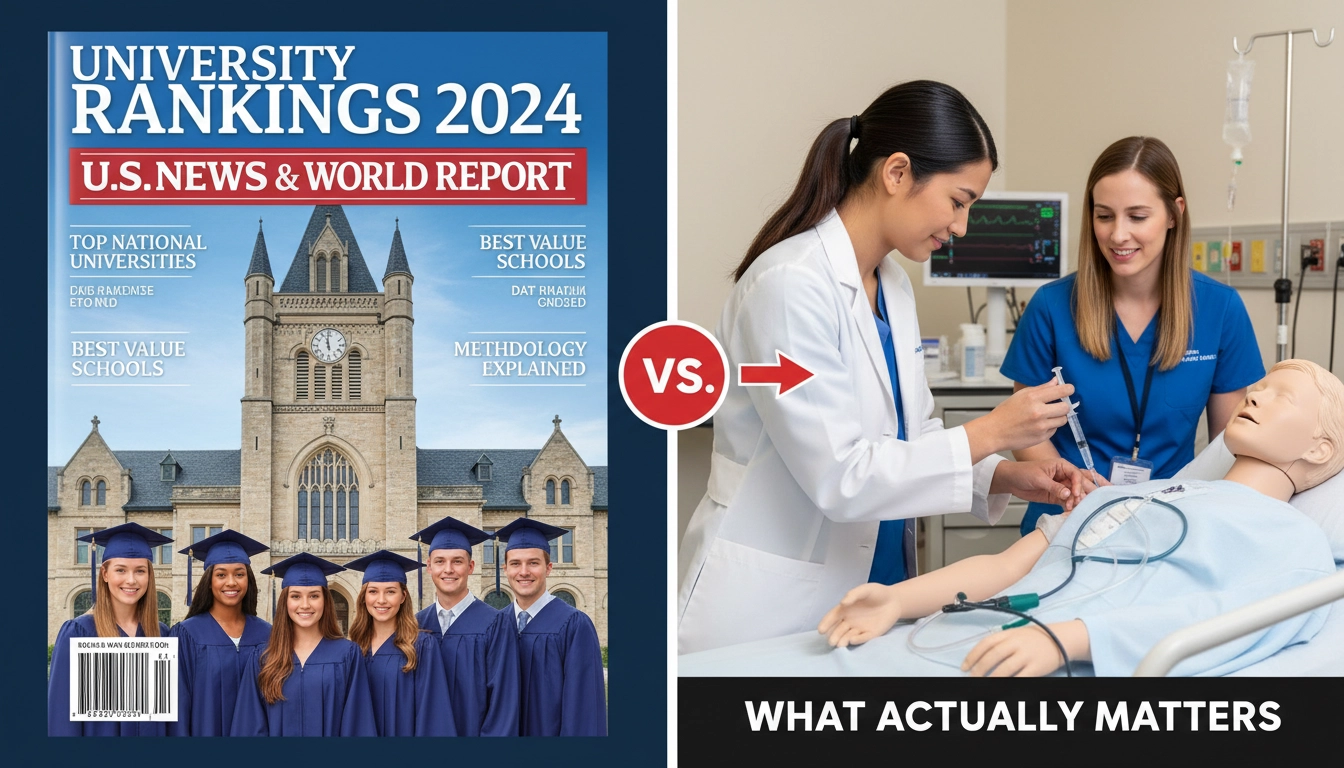
The national RN vacancy rate hit 9.6% in 2026, and the average hospital now spends 83 days trying to fill a single experienced nursing position. That's not a blip — that's a structural workforce gap that's been building for years. More than 1 million experienced RNs are projected to retire by 2030, most from the most clinically seasoned segment of the workforce. For students choosing a nursing program right now, this matters enormously. You're not entering a crowded field hoping for scraps. You're entering one where your degree, your clinical training, and the hospital relationships embedded in your school's network will shape hiring outcomes for the better part of a decade. That means the school you pick deserves more careful thought than just checking where it lands on a ranked list.
What Rankings Actually Measure (and What They Miss)
U.S. News rankings are a reasonable starting point. They lean heavily on peer assessment surveys — nursing school deans grading each other's programs. That captures reputation, which matters. But it doesn't tell you whether clinical placements go to Level I trauma centers or community hospitals, or whether graduates pass the NCLEX the first time.
The NCLEX first-time pass rate is the most honest single measure of whether a school teaches nursing well — not how it performs in peer assessment surveys.
The national first-time NCLEX-RN pass rate sits around 87.5%, according to NCSBN. Programs consistently clearing 95% are doing something right in their curriculum. Programs below 85% deserve real scrutiny before you commit.
Accreditation is non-negotiable, but the type matters too. Both CCNE (Commission on Collegiate Nursing Education) and ACEN (Accreditation Commission for Education in Nursing) are legitimate. Some Magnet-designated hospitals informally prefer CCNE-accredited graduates (worth a quick call to HR at your target hospital before choosing a program).
Then there's the clinical placement network — the factor most rankings skip entirely. Where you train shapes where you get hired. Johns Hopkins students rotate through Hopkins Hospital. Penn students train within Penn Medicine. That's a meaningfully different career-launching experience than a community hospital rotation.
Graduation rate is worth checking too. Programs below 60% are often struggling with poor student support or unrealistic course loads. It's a proxy for how well a school backs its students through a genuinely difficult curriculum.
| Metric | What to Look For |
|---|---|
| NCLEX first-time pass rate | 90%+ strong; 95%+ exceptional |
| Accreditation | CCNE or ACEN (verify employer preferences) |
| Clinical hours required | Federal minimum is 500; top programs exceed 750 |
| NIH research funding (grad) | Signals faculty quality and research access |
| Graduation rate | Below 60% warrants investigation |
Top BSN Programs for 2026
University of Pennsylvania sits at #1 in U.S. News's 2026 undergraduate nursing rankings and also tops QS World University Rankings globally. Penn's prelicensure BSN graduates have averaged a 93% first-time NCLEX pass rate over the past decade. That consistency is harder to fake than survey scores.
The trade-off is price and selectivity. Penn's graduate nursing programs run to a total cost of $85,822, with 62% of students receiving some financial aid. It's an investment that pays off primarily for students heading into research, advanced practice, or highly competitive hospital systems.
Johns Hopkins made a significant structural shift recently: it replaced its traditional prelicensure BSN with a Direct Entry MSN designed for students who already hold a bachelor's degree in any other field. The first five graduating classes from that program posted a 95% NCLEX pass rate. The program takes roughly three years to complete and includes rotations through Hopkins Hospital and affiliated sites. Not a shortcut — a rigorous redesign aimed squarely at career changers.
Duke University lands at #3, built around evidence-based practice and deep ties to the Duke Health system. Clinical rotations within an academic medical center from day one is a real advantage most programs can't replicate.
| School | US News 2026 Rank | NCLEX Pass Rate | Distinct Strength |
|---|---|---|---|
| University of Pennsylvania | #1 | ~93% | Global research reputation |
| Johns Hopkins | #2 | ~95% (Direct Entry MSN) | Research, global health |
| Duke University | #3 | 95–98% | Evidence-based clinical training |
| UNC Chapel Hill | #7 | 95%+ | Public health integration |
| UCLA | #8 | High | Research, patient population diversity |
| University of Iowa | Top 10 | Strong | Rural health, evidence-based focus |
Best Graduate Programs: MSN and DNP
Graduate nursing is where career trajectories split sharply. A Certified Registered Nurse Anesthetist earns around $214,000 per year on average. A family nurse practitioner earns differently. The graduate program you choose sends you down one of these paths.
UCSF School of Nursing has received more NIH research funding than any other nursing school in the country over the past decade. Its MSN offers more than a dozen clinical tracks, including multiple nurse practitioner and clinical nurse specialist pathways. Tuition runs about $40,000 per year for in-state students. Admission is selective — roughly 25–35% of applicants receive interview invitations. That's not a reason to avoid applying; it's a reason to prepare a strong application.
Emory University tops U.S. News's 2026 DNP rankings. Its Atlanta campus sits adjacent to CDC headquarters, which creates public health research and partnership opportunities that most programs simply can't match. Clinical training flows through the Emory Healthcare network, which handles high-acuity, high-volume cases at scale.
Vanderbilt University earns consistent top-10 placement for MSN programs, particularly in nurse-midwifery and pediatric nursing. Its simulation infrastructure is widely considered among the best in the country — something prospective students can actually evaluate during a campus visit, which is worth doing before committing.
Programs That Don't Make the Headlines (But Should)
University of Washington is regularly tied for #1 in QS global nursing rankings yet gets minimal attention in U.S.-focused coverage. UW's programs in global health and community nursing are among the strongest in the country. In-state tuition makes it accessible in a way that private alternatives aren't. Its ties to Washington State's healthcare system also create clinical exposure to Pacific Northwest community health challenges, including Native American population health — experience that is hard to find elsewhere.
Oregon Health & Science University (OHSU) has built a clinical training environment specifically suited to rural and underserved community care. If your goal is practicing in rural or frontier settings, OHSU's clinical network is probably better preparation than anything offered inside a major metropolitan academic medical center. Their rural rotations cover settings that Penn or Hopkins simply can't replicate.
University of Alabama at Birmingham earns high marks for advanced practice and leadership programs while charging significantly less than comparable coastal options. It tends to get overlooked by students outside the Southeast. That's their loss, not the school's problem.
For cost-conscious students in the West, BYU-Idaho offers a CCNE-accredited BSN at approximately $4,118 per year. The numbers are real: this is a four-year accredited program, not an online degree mill. For students who need an affordable path to licensure, it deserves serious consideration.
Matching a Program to Your Career Goals
Choosing a nursing school without a career target is like buying running shoes before you know if you're trail running or sprinting. Here's a working framework:
- ICU or trauma nursing at a Magnet hospital: Penn, Hopkins, Duke, UCSF. Their clinical networks and brand recognition open those doors faster.
- Advanced practice (NP, CNS pathway): UCSF, Vanderbilt, Emory, UNC Chapel Hill. Look for direct articulation into graduate tracks and strong clinical mentorship.
- Rural or community health: OHSU and UW will serve you better than any Ivy. Their networks are built for that environment.
- Tight budget without sacrificing accreditation: State schools in Iowa, Kentucky, and Alabama — and BYU-Idaho at the undergraduate level — are accredited programs at a fraction of private-school cost.
One non-obvious point: if you know graduate school is in your future, look for BSN programs with formal articulation agreements into MSN tracks. Some schools offer guaranteed or priority admission to their own graduate programs for high-performing BSN graduates. Paying full-rate tuition twice over at disconnected institutions is a financing mistake that's avoidable with upfront planning.
Also worth knowing about CRNAs specifically: that certification requires a separate application to specialized graduate programs after you've accrued at least one to two years of ICU experience post-BSN. Your undergraduate school matters less for CRNA admission than your clinical track record in those ICU years.
The Real Cost and the Return on It
The price range is enormous. Johns Hopkins graduate nursing programs run $60,000 to $70,000 per year. BYU-Idaho's BSN sits under $5,000 per year. A solid state-school BSN might cost $20,000 total in-state.
The return-on-investment case for nursing is strong, but it depends heavily on how much you borrow. The Bureau of Labor Statistics puts the median RN salary at $93,600. A graduate who spends $30,000 on a state-school BSN and earns that salary for 30 years has a very different financial story than someone who finances $180,000 for a private-school BSN at 7% interest. The math on that second scenario is genuinely painful.
Financial aid patterns matter too. About 62% of Penn's nursing students receive some aid, but average aid rarely closes the gap to affordable for most families. At state schools, HRSA nursing scholarships and loan forgiveness programs for working in underserved areas can meaningfully change the total cost picture — worth researching before ruling out programs based on sticker price alone.
The credential level where prestige actually pays is graduate nursing. NP and CRNA programs at well-regarded institutions do drive better clinical placement and higher earning ceilings. That's where spending more is defensible.
My honest read: at the BSN level, a school's NCLEX pass rate and accreditation status matter far more than its name. Spend less, get licensed, and invest the difference in a strong graduate program if that's where your career is headed.
Bottom Line
- NCLEX pass rate and CCNE/ACEN accreditation are the two metrics that matter most for BSN programs. Brand name is secondary at the undergraduate level.
- For academic reputation and research access, Penn (#1), Hopkins (#2), and Duke (#3) lead the 2026 U.S. News undergraduate rankings — with tuition costs to match.
- UCSF is the graduate program to beat for NIH research funding and NP clinical depth. Emory leads the 2026 DNP rankings.
- If cost is a real constraint, state schools and BYU-Idaho offer accredited paths to licensure at a fraction of private-school prices, with NCLEX outcomes that hold up under comparison.
- Know your end goal before you pick a school. A student aiming for rural NP practice and a student aiming for a trauma ICU at a Magnet hospital should not be applying to the same list.
Frequently Asked Questions
What is the #1 nursing school in the United States in 2026?
According to U.S. News's 2026 rankings, the University of Pennsylvania holds the top spot for undergraduate BSN programs. For graduate programs, Johns Hopkins leads the MSN rankings and Emory University tops the DNP list. QS World University Rankings places Penn and the University of Washington tied at #1 globally for nursing.
Does it actually matter which nursing school I attend?
For BSN programs, accreditation status and NCLEX pass rate matter more than school prestige in most hiring contexts. For graduate programs — MSN, DNP, and CRNA tracks — the research environment, faculty connections, and clinical partnership network have a more measurable effect on career placement and trajectory.
What NCLEX pass rate should I expect from a strong nursing program?
Target programs where the first-time NCLEX-RN pass rate is consistently above 90%. Programs clearing 95% year over year are demonstrating strong curriculum and student preparation. The national average sits around 87.5%, per NCSBN data, so anything well below that number warrants a close look at why.
What's the difference between CCNE and ACEN accreditation — does it matter?
Both are nationally recognized accreditors. CCNE focuses exclusively on baccalaureate and graduate programs; ACEN covers a broader range including associate degree programs. Both are accepted by nursing licensing boards in all 50 states. The practical difference is that some Magnet-recognized hospital systems informally prefer CCNE-accredited graduates, so if you have a specific hospital in mind, it's worth asking their HR team before committing.
Should I get an ADN or go straight for a BSN?
An ADN gets you licensed faster at lower cost. The problem is that many hospital systems — especially Magnet-designated facilities — now require a BSN for RN positions or use it as a tiebreaker in hiring. Most ADN-educated RNs end up completing an RN-to-BSN bridge program within a few years of graduation anyway. If you can swing the time and money for a BSN upfront, you're avoiding that second round of school and the career friction that comes with it.
Is nursing still a strong career choice in 2026?
The labor data is clear. The BLS projects 5% job growth through 2034, the national RN vacancy rate sits at 9.6%, and more than 1 million RNs are projected to retire by 2030. It's one of the most demand-backed professions available to new graduates right now. The question isn't whether jobs exist — it's which type of nursing fits your goals and which program gets you there most efficiently.
Sources
- 2026 Best Undergraduate BSN Programs - US News Rankings
- Top Graduate Nursing Programs for 2026: US News via Becker's Hospital Review
- NCLEX Pass Rates - NCSBN
- Registered Nurses: Occupational Outlook Handbook - BLS
- Nurse Shortage Statistics in US 2026 - The World Data
- Best Nursing Universities in the United States for 2026 - Mastersportal