Cooper Union: Programs, Rankings, and Student Life
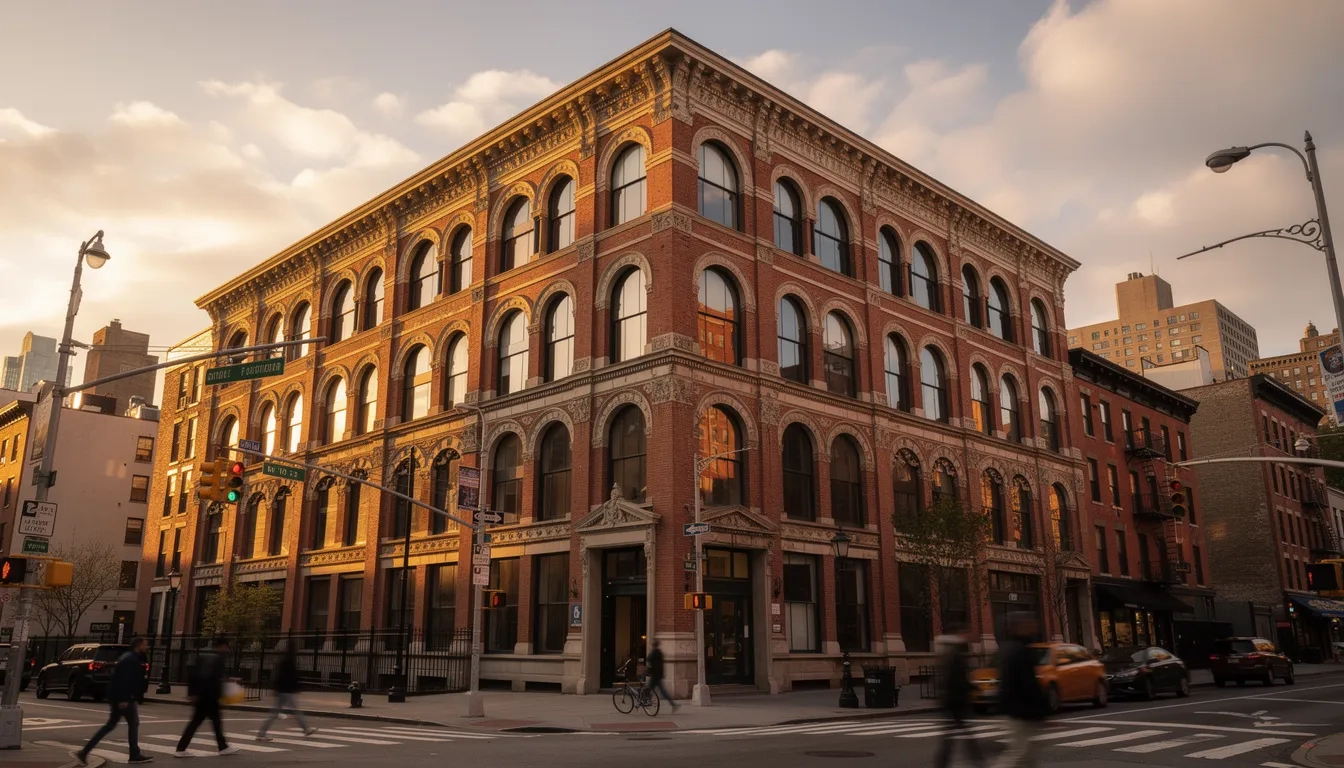
Peter Cooper had almost no formal education. He taught himself, built a glue factory, then an iron foundry, then laid the first successful transatlantic telegraph cable. By 1859, he was rich enough to do something unusual: build a college in Manhattan and give it away for free. Not free for the wealthy. Free for anyone who qualified. That founding idea drove Cooper Union for 155 years. Then, in 2014, it nearly broke the institution.
The Tuition Story Nobody Fully Tells
For most of its existence, free tuition was the single fact that defined Cooper Union. No other selective urban institution offered anything close. Then the board announced tuition charges would begin, citing a roughly $23 million deficit tied partly to cost overruns on a new building. Students occupied the president's office. Alumni wrote open letters. The backlash was swift.
The school did not reverse course entirely, but it has been walking it back ever since. Here's where things stand now:
- Every undergraduate receives a half-tuition scholarship worth $22,275 per year
- The average net price for federal loan recipients is $14,580 annually
- 99% of undergraduates received some form of financial aid in 2023
- In September 2024, Cooper Union announced all seniors would receive tuition-free education
- The school now covers roughly 83% of undergraduate tuition through scholarships
- The stated goal: full tuition coverage restored by fiscal year 2029
Cooper Union was built on the idea that a first-class education in art, architecture, and engineering belongs to any qualified student — not just the ones who can afford it. The institution is, slowly, returning to that principle.
The arc matters if you're comparing financial aid packages. A $14,580 average net price in Manhattan, at a school ranked #1 in Best Value by U.S. News, is genuinely hard to beat. It's not fully free yet. But the trajectory is clear and the commitment is institutional.
Three Schools, Three Very Different Acceptance Rates
Cooper Union is not a university in the conventional sense. It has three schools, each with its own culture, admissions process, and acceptance rate. They share a campus, share humanities coursework, and occasionally share studios. But applying to one is nothing like applying to another.
| School | Degree | Acceptance Rate (2025–2026) |
|---|---|---|
| Irwin S. Chanin School of Architecture | 5-year B.Arch (NAAB-accredited) | 4% |
| School of Art | 4-year BFA | 8% |
| Albert Nerken School of Engineering | B.E. / B.S. in CS / M.E. | 16% |
| Overall | — | 11% |
The School of Architecture is, by the numbers, among the hardest programs to enter in the country. A 4% acceptance rate places it alongside the most selective programs anywhere. The evaluation process weighs portfolio quality heavily — test scores matter far less than what you make. Students who get in spend five years in an intensive design studio environment that architecture schools elsewhere try to replicate.
The School of Art offers a BFA with an integrated curriculum covering painting, sculpture, drawing, photography, audiovisual work, graphic design, and printmaking. It's genuinely interdisciplinary in practice, not just catalog language. Studios are open late, and students regularly collaborate across schools in ways that would be logistically impossible at a 30,000-person university.
The Albert Nerken School of Engineering offers degrees in chemical, civil, electrical, and mechanical engineering, plus a B.S. in computer science and a Master of Engineering. At 16% acceptance, it's selective without being impossible. About 53% of Cooper Union's 834 undergraduates are in engineering, making it the largest school by enrollment. The 72 graduate students split between engineering MS (72%) and architecture MS (28%).
One practical thing worth knowing: Cooper Union does not offer Early Action, only binding Early Decision. If you're building a balanced application list, that constraint shapes your entire timeline.
Rankings: What the Numbers Actually Mean
Rankings are a blunt instrument. But Cooper Union's position across the major systems tells a coherent story.
According to U.S. News 2026 rankings and additional sources:
- #1 Best Value Schools (U.S. News, 2026)
- #2 Regional Colleges North (U.S. News, 2026)
- #9 Best Undergraduate Engineering Programs (U.S. News, 2026)
- #1 Best Art School in the U.S. (Art & Object, 2024)
- #9 Best Architecture Colleges (Niche, 2026)
- #20 Best Small Colleges (Niche, 2026)
The "Regional Colleges North" designation frustrates some applicants who see it as underselling the school. But it reflects Cooper Union's structure honestly: no doctoral programs, limited research infrastructure, narrow scope. Within that category, it dominates.
The #9 engineering ranking is the one that tends to surprise people. It places Cooper Union alongside schools with endowments ten times its size. The 82% six-year graduation rate (for the cohort entering fall 2019) and 89% sophomore retention rate suggest students aren't just getting in — they're finishing.
Campus: History in Your Daily Walk
The Foundation Building, completed in 1858, predates the school itself by a year. It's a National Historic Landmark. On February 27, 1860, Abraham Lincoln stood in its Great Hall and delivered what became known as the "Right Makes Might" address — the speech that galvanized support for his presidential nomination. Frederick Douglass, Susan B. Anthony, Mark Twain, Theodore Roosevelt, Barack Obama, and Bill Clinton have all spoken from that same stage.
That's not decorative history. It says something about what the institution believes public discourse is for.
The newer anchor is 41 Cooper Square, completed in 2010 and designed by Pritzker Prize-winning architect Thom Mayne. At 175,000 square feet with Platinum LEED certification, it houses studios, labs, and classrooms for engineering and art. It's also, somewhat ironically, the building whose cost overruns contributed to the 2014 tuition crisis. Worth knowing.
Both buildings sit in Manhattan's East Village, with two major subway lines within walking distance. This is not a sequestered campus where college life unfolds in isolation. You're in New York, and New York finds its way into your coursework whether you plan for it or not.
Student Life: Small School, Enormous City
71% of first-year students live on campus. After that, most move into the surrounding neighborhood (the East Village, for all its expense, remains more residential than Midtown). The commute to campus for upperclassmen is often measured in subway stops, not miles.
The city functions as an extended campus. Internships at architecture firms, galleries, and tech companies are accessible in a way that wouldn't be possible from a suburban school. Professors frequently have active professional practices in New York. Studio critiques sometimes pull in working designers, architects, and artists from the surrounding industry.
On-campus, roughly 80 clubs run each year — a ratio of about one club for every ten students. They span literary and performance groups, professional and honor societies, ethnic and cultural organizations, religious clubs, and recreational sports. Varsity programs include soccer and volleyball (both men's and women's), with club teams in football, rowing, and sailing. Intramural options cover basketball, bowling, softball, and volleyball.
Student demographics tell an important story:
- 21% first-generation college students
- 34% Asian, 27% White, 11% Hispanic/Latino, 5% Black
- 51% female / 46% male / 3% nonbinary
That 21% first-generation figure is significantly higher than you'd expect at a school this selective. It connects directly to Peter Cooper's original intent: talent and financial background shouldn't be the same thing.
The 8:1 student-to-faculty ratio means you are not anonymous here. In a school of 834 undergraduates, you will know your professors. That cuts both ways: more mentorship, but also nowhere to hide if you fall behind.
The Alumni Record
Cooper Union's alumni output, per student enrolled, is difficult to match anywhere. The numbers from official records include 40 Fulbright scholars since 2001, 26 Guggenheim Fellowships, 3 MacArthur Fellowships, 13 NSF Graduate Research Fellowships since 2004, one Nobel Prize in Physics, and one Queen Elizabeth Prize for Engineering.
The Nobel went to Russell Alan Hulse, who shared the 1993 Physics prize with Joseph Hooton Taylor Jr. for discovering a new type of pulsar — a finding that provided the first indirect evidence for gravitational waves, decades before LIGO confirmed them directly.
Ricardo Scofidio and Elizabeth Diller, both Cooper Union graduates, co-founded Diller Scofidio + Renfro and became the first architects ever to win a MacArthur Prize. Lee Krasner pioneered Abstract Expressionism in the 1940s through the 1960s. Augusta Savage was a sculptor and educator central to the Harlem Renaissance. Milton Glaser designed the I Love New York logo, among a career full of other lasting work.
Twenty-six Guggenheim Fellowships from a school that graduates fewer than 200 students a year is a striking per-capita number. The Guggenheim is awarded to roughly 200 people annually across all fields, drawn from thousands of applications. Twenty-six from one small institution signals something real about what's happening educationally here.
Should You Apply?
My honest read: Cooper Union is one of the most underrated options in American higher education, and the ongoing return toward free tuition makes the case stronger each year. But it's not the right fit for everyone, and understanding the mismatch is as useful as understanding the appeal.
Apply if:
- You're certain about your field. Architecture, art, or engineering. The school is narrow by design.
- Your portfolio is genuinely strong. For art and architecture especially, the application lives or dies on what you make.
- You want serious financial relief without compromising on rigor or location.
- You want to be in New York City, embedded in a small, intense community of people who take their craft seriously.
Think twice if:
- You want a traditional college experience with big social programming, a football culture, or a sprawling campus. None of that exists here.
- You're applying to engineering assuming 16% is an easy door. It isn't.
- You're undecided about your direction. You apply to one school, not to the university at large.
One recent development worth weighing: in January 2026, Cooper Union settled a federal investigation into campus antisemitism following an October 2023 incident in which Jewish students sheltered in a library during a pro-Palestinian demonstration. The settlement requires revised anti-harassment policies and staff training. How the administration follows through on that is worth monitoring before you commit.
The fundamental case for Cooper Union remains strong. It was built on an unusual premise, it has produced unusual alumni, and it charges an unusual price. For the right student, that combination is hard to find anywhere else.
Bottom Line
- Best-fit students are those with a defined focus in one of three fields, a strong portfolio, and genuine interest in being embedded in New York City's professional world from day one
- The half-tuition scholarship plus the path toward full coverage by 2029 makes the financial equation increasingly favorable — the $14,580 average net price is competitive against schools half as selective
- Architecture (4%) and art (8%) are portfolio-driven; start building your application materials in the spring of 11th grade to have time to refine your work before November Early Decision deadlines
- The 8:1 faculty ratio and small cohort create mentorship that large engineering schools genuinely cannot replicate
- Monitor how the school implements the January 2026 federal settlement on campus climate — it's recent, and the follow-through matters
Frequently Asked Questions
Is Cooper Union actually free?
Not entirely, but it's heading back in that direction. As of 2024–2025, every undergraduate receives a half-tuition scholarship ($22,275/year), and the school covers roughly 83% of total tuition costs through institutional aid. Seniors already receive tuition-free education as of fall 2024. The goal is 100% coverage by fiscal year 2029.
Why did Cooper Union stop being free in the first place?
In 2014, the board began charging tuition after the institution accumulated roughly a $23 million deficit, tied significantly to cost overruns on the 41 Cooper Square building that opened in 2010. The move was deeply controversial — students occupied the president's office and alumni organized publicly in protest. The school has been gradually rolling back tuition charges ever since.
Do I apply to Cooper Union as a whole, or to a specific school?
You apply to one of the three schools specifically — architecture, art, or engineering — not to Cooper Union as a general institution. Each has its own acceptance rate and admissions criteria. For art and architecture, portfolio quality carries more weight than standardized test scores.
Is the engineering ranking legitimate, or is it inflated by the school's small size?
U.S. News ranks the undergraduate engineering program #9 nationally for 2026, placing it ahead of many large research universities with far greater resources. The 13 NSF Graduate Research Fellowships since 2004 and a Queen Elizabeth Prize for Engineering alumnus support the ranking. The tradeoff is that Cooper Union's engineering program is narrower in specialization than a large school with dozens of research centers.
What does Cooper Union's student body actually look like?
834 undergraduates, 72 graduate students, and an 8:1 student-to-faculty ratio. Demographics: 51% female, 34% Asian, 27% White, 11% Hispanic/Latino, and 21% first-generation college students — that last number is notably high for a school this selective and reflects the financial aid structure's actual reach.
Can you transfer into Cooper Union?
Cooper Union does accept transfer students, though spots are limited and the process is competitive. Transfer applicants to art and architecture must submit portfolios. Prospective transfers should contact the Office of Admissions directly, as transfer class sizes vary by year and available spots depend on attrition in each school.