Disputing Student Loan Errors on Your Credit Report
Your credit report says your student loan balance is $61,400. Your servicer's portal says $43,800. Three years of on-time payments don't explain the gap. Two of those numbers are wrong — and the wrong ones are quietly costing you on every mortgage application, rental background check, and car loan you pursue.
Student loan credit reporting errors have become a national-scale problem. A Senate investigation released in December 2024 found that MOHELA may have contributed to nearly 2 million duplicate student loan entries appearing on borrowers' credit reports, following the chaotic 2023 transfer of accounts from Nelnet. Over 100,000 borrowers saw their scores wrongly impacted for up to 18 months. No missed payments. No defaults. Just a bureaucratic handoff that nobody managed correctly.
The fix isn't instant. But it is far more achievable than most people realize — if you work the right process in the right order.
Why Student Loan Errors Are So Common Right Now
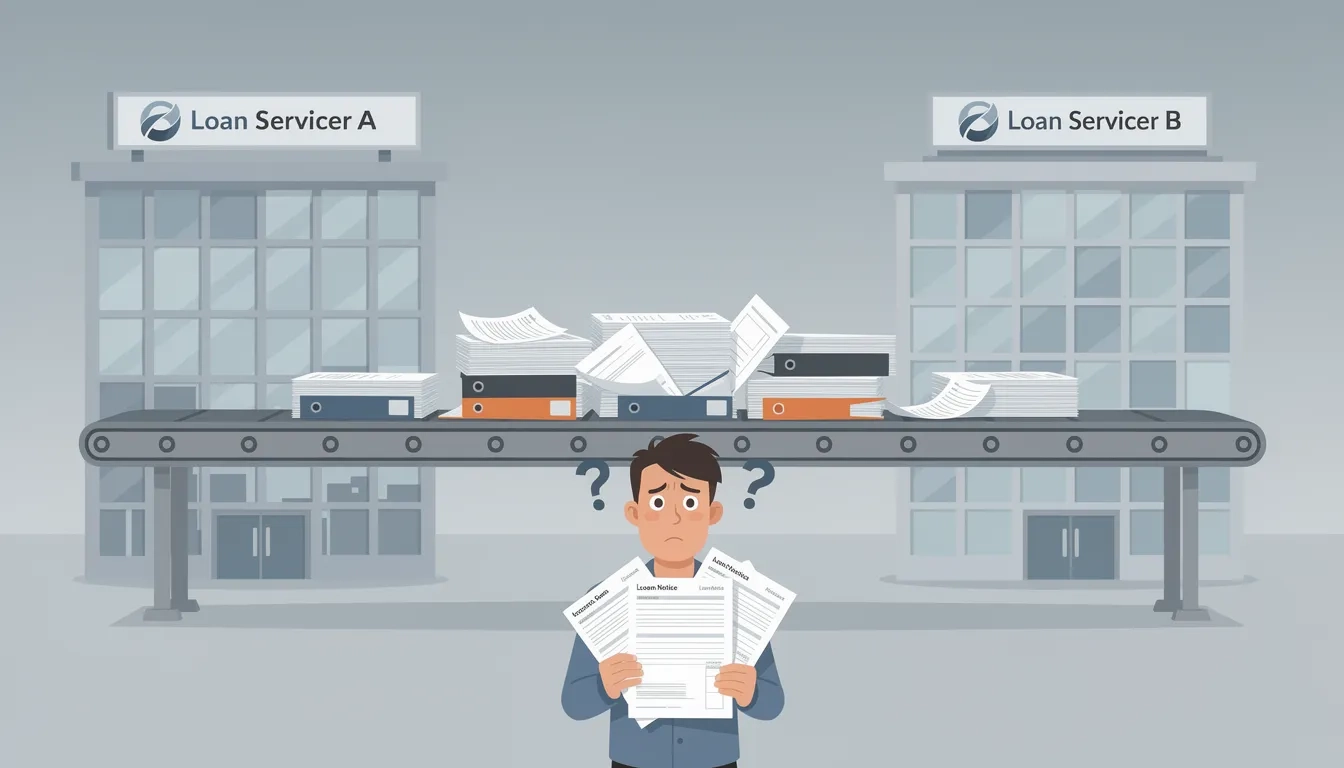
Loan servicer transfers are the biggest culprit. When accounts move from one servicer to another, there's a window where both the outgoing and incoming servicer report simultaneously. The same loan appears twice on your credit file, each entry showing the full balance. A borrower who owes $50,000 suddenly looks like they owe $100,000.
That's exactly what happened during the 2023 Nelnet-to-MOHELA migration. The Senate investigation — led by Senators Elizabeth Warren and Richard Blumenthal, among others — found that MOHELA failed to give credit bureaus advance notice of the transfer, creating duplication errors at scale. The Department of Education eventually announced it would move accounts away from MOHELA by end of 2025, but the credit damage had already been done for hundreds of thousands of borrowers.
The structural problem is this: credit bureaus don't verify data before posting it. They receive electronic submissions from servicers and add it to your file automatically. Equifax, Experian, and TransUnion are data furnishers, not auditors. The burden of proof falls on you.
Two class action lawsuits filed in 2025 and 2026 allege the Department of Education is pushing inaccurate data for millions of borrowers — doubled balances, phantom delinquencies. This isn't a one-person glitch. It's a systemic failure affecting people trying to buy homes and pass job screenings.
The Types of Errors That Actually Matter
Not all errors hit your score equally. Some are cosmetic; others can drop your credit score by 80 or more points within a single reporting cycle.
The most damaging student loan errors to look for:
- Duplicate accounts: The same loan listed twice, doubling your apparent debt load and wrecking your debt-to-income ratios
- Wrong balance: Payments misapplied, interest capitalized incorrectly, or fees added without authorization
- Incorrect payment status: A loan flagged as delinquent when you've been paying on time
- Discharged loans still showing as active: PSLF and IDR forgiveness can take months to reach the bureaus after approval
- Wrong dates: Incorrect account opening or closing dates change how long negative items sit on your report
- Identity mix-ups: Another borrower with a similar name having their loans appear on your file (this happens more often than lenders will admit)
One detail most guides skip: federal student loans typically can't be reported as late until 90 days past due, while private student loans can be flagged after just 30 days of nonpayment. If you see a federal loan showing delinquent at day 45 or 60, that's a reporting error — full stop.
"Filing a dispute doesn't hurt your credit score. The error itself is what's doing the damage — and the longer it sits unreported, the longer it compounds."
Pulling Your Reports and Building a Paper Trail
Before writing a single dispute letter, get your evidence in hand. Without documentation, you're just arguing.
Start at AnnualCreditReport.com — the only official source for free credit reports from all three bureaus. Since 2020, Equifax, Experian, and TransUnion have made weekly free access permanent. Pull all three. Not just one. Errors often appear on TransUnion but not Equifax, which means if you dispute with only one bureau, two-thirds of lenders checking your file still see the problem.
For federal loans, also download your National Student Loan Data System (NSLDS) report from StudentAid.gov. The NSLDS is the federal government's authoritative record of your loan history, current balances, and servicer assignments. When your credit report contradicts your NSLDS data, that contradiction is your primary exhibit.
Document everything as you go. Screenshot your online dispute submissions with timestamps. Save confirmation numbers. Any physical correspondence should go by certified mail with USPS return receipt (Form 3811, the green card) — when the servicer signs it, you have a dated, signed proof of delivery. That matters if things escalate to a CFPB complaint or attorney.
Keep a simple running log of every contact: date, method, name of representative if applicable, outcome. It takes about 45 seconds per entry and becomes critical evidence if you need to make a legal case later.
The Actual Dispute Process, Step by Step
The dispute process runs on two parallel tracks: your loan servicer and the three credit bureaus. Most people work one at a time. Don't. Run both simultaneously.
Track 1 — Dispute with your servicer. For federal loans, log into your servicer account, find the discrepancy, and submit a written dispute. Be specific about numbers and dates: "My account shows a balance of $61,400 as of June 2026. My NSLDS data and payment records show the balance should be approximately $43,800. Please correct the information you are reporting to all three credit bureaus." Vague disputes get vague responses. Specific ones with dollar amounts and dates are harder to dismiss.
Track 2 — File with all three bureaus simultaneously. Each bureau has an online dispute portal (fast and convenient). Sending a written dispute by certified mail creates a stronger paper trail for any future legal claim (slower, but better documented). Many consumer attorneys recommend doing both: submit online for speed, then mail the same dispute the same day.
Here's what a complete dispute packet should include:
| Document | What It Proves |
|---|---|
| Credit report with the error highlighted | Shows exactly what you're challenging |
| NSLDS report or servicer account statement | Shows what the correct data should be |
| Payment confirmation records | Proves on-time payment history |
| Prior correspondence with your servicer | Documents your first attempt to resolve it |
| Certified mail receipt | Establishes timeline and proof of delivery |
Always send copies, not originals. If original documents get lost, your evidence disappears with them.
One more thing: keep making your loan payments during the dispute. Some borrowers stop paying while a dispute is pending, treating the loan as "contested." That creates a new, legitimate delinquency layered on top of the original error. Keep paying unless your servicer confirms in writing that they've placed the account in formal dispute hold.
What Happens After You File
Under the Fair Credit Reporting Act, credit bureaus have 30 days to investigate after receiving your dispute — extended to 45 days if you submit additional information during that window. Within five business days of completing the investigation, they must send you the results.
Three possible outcomes:
- Error confirmed and corrected. Give it 30 days, then re-pull all three reports to confirm the correction actually appears everywhere. Don't assume it propagated automatically.
- Information "verified." In practice, this usually means the bureau re-contacted the servicer, the servicer confirmed the same data they originally submitted, and the bureau accepted that as sufficient. It's circular reasoning, not an actual investigation — and it happens constantly.
- Request for more documentation. Respond promptly and specifically with whatever they've asked for.
If the bureau verifies something you know is wrong, add a 100-word consumer statement to your credit file. Every lender who pulls your report will see it. This doesn't fix the error, but it tells your side of the story for any creditor reviewing your file while you work the escalation process.
Escalating to the CFPB, FSA Ombudsman, and Attorneys
If 30 days pass without a response, or your dispute gets rejected and the error is real, it's time to escalate. The path depends on your loan type:
Federal student loans:
- Federal Student Aid Ombudsman at StudentAid.gov — the government's own dispute resolution office for federal loan issues
- Consumer Financial Protection Bureau at consumerfinance.gov/complaint
- Your state's student loan ombudsman, if your state has one
Private student loans:
- CFPB complaint
- State attorney general's office
- Consumer protection attorney
The CFPB complaint is worth filing even while you're still in the middle of the servicer process. Companies respond to CFPB complaints faster than to individual borrower letters. There's a federal response requirement, and filings feed into a public database that regulators actively monitor.
Here's my honest take: if an error has knocked 40 or more points off your credit score and your servicer isn't moving, talk to a consumer protection attorney. Under the FCRA, if you prove a furnisher reported inaccurate information and failed to correct it after a proper dispute, you're entitled to actual damages, statutory damages up to $1,000 per violation, and attorney's fees. That attorney's fees provision — codified at 15 U.S.C. § 1681o — means many consumer law firms take FCRA cases on contingency. You pay nothing unless you win.
Most borrowers give up after the first rejection. That's exactly what servicers are counting on. The FCRA was specifically written to make this fight worth having.
Bottom Line
- Pull free weekly reports from AnnualCreditReport.com and your NSLDS report from StudentAid.gov before filing anything — you need evidence before you argue.
- Dispute with your servicer AND all three bureaus simultaneously, not one at a time.
- Send everything by certified mail with return receipt; screenshot your online submissions too.
- Under the FCRA, bureaus have 30 days to investigate. If they "verify" an obvious error, escalate to the CFPB immediately.
- If the error is material — costing you a mortgage, a job offer, or 40+ credit score points — consult a consumer protection attorney. The FCRA's fee-shifting provision often makes that help free until you win.
Frequently Asked Questions
Can disputing a student loan error hurt my credit score?
No. Filing a dispute has zero effect on your credit score. The error is what's causing damage; the dispute is the process for removing it. The Fair Credit Reporting Act explicitly protects your right to challenge inaccurate information without penalty.
What if my student loan was legitimately delinquent — can I still dispute specific errors?
Yes. Even if you genuinely missed payments, you can dispute any piece of information that's inaccurate. A legitimate delinquency reported with the wrong date, wrong dollar amount, or listed as two separate entries is still a disputable error. You can't wipe accurate negative history — but inaccurate reporting of accurate debts is still a FCRA violation.
How long do student loan errors stay on a credit report if I don't dispute them?
Most negative student loan items — late payments, delinquencies — stay on your report for seven years from the date of the first missed payment. That's a long time to absorb higher interest rates and loan denials. The error doesn't disappear faster just because it's inaccurate; you have to actively dispute it.
What is the FSA Ombudsman and when should I contact them?
The Federal Student Aid Ombudsman is the Department of Education's neutral dispute resolution office for federal loan borrowers. Contact them after you've already tried your servicer and haven't gotten a satisfactory result. They don't have enforcement authority, but they can often facilitate corrections that servicers won't make independently. Access them at StudentAid.gov/help.
My loan shows as discharged but is still listed as active on my credit report. What do I do?
File disputes with all three bureaus as soon as the discharge is confirmed, attaching your discharge approval letter as documentation. PSLF and IDR forgiveness discharges have a known reporting lag. The CFPB has issued guidance specifically on this — servicers are required to update credit reporting within a reasonable timeframe after discharge, and failing to do so is a reportable violation.
Can I sue my loan servicer for credit reporting errors?
Yes, under the FCRA. If a servicer (the "furnisher" of your data) reported inaccurate information and failed to correct it after you followed the proper dispute process, you may have a valid legal claim. Potential recovery includes actual damages from the error, statutory damages up to $1,000 per violation, and attorney's fees. Many consumer attorneys handle these cases on contingency, meaning you pay nothing upfront.
Sources
- Dispute Student Loans on Your Credit Report: Your Guide – Upsolve
- How to Dispute Student Loan Errors: Balances, Terms, and Forgiveness Denials – Tate Esq
- How to Dispute Student Loans on Your Credit Report – Tate Esq
- Senate Investigation Reveals MOHELA May Have Contributed to Nearly 2 Million Student Loan Duplication Errors – Senator Warren
- Student Loan Servicer Transfer Led to 'Millions of Consumer Credit Reporting Errors' – NBC News
- FCRA Credit Reporting Errors — How to Dispute the Right Way – Ginsburg Law Group