How to File FAFSA Without Parental Information
The FAFSA makes a bold assumption: your parents are part of your financial picture. For millions of students, that assumption is just wrong. Whether you've aged out of foster care, don't know where your parents live, or are sleeping on a cousin's couch between classes, the system was not built with you in mind. But pathways exist. They're just buried.
According to Lumina Foundation data, 49% of college students are financially independent from their parents — yet the FAFSA defaults to treating almost everyone under 24 as a dependent. That gap creates real consequences. Students who need the most aid often can't access it because they can't get a parent to cooperate with a form.
Here's exactly how to file FAFSA without parental information, who qualifies, and what to do when you're stuck.
Who Automatically Qualifies as an Independent Student
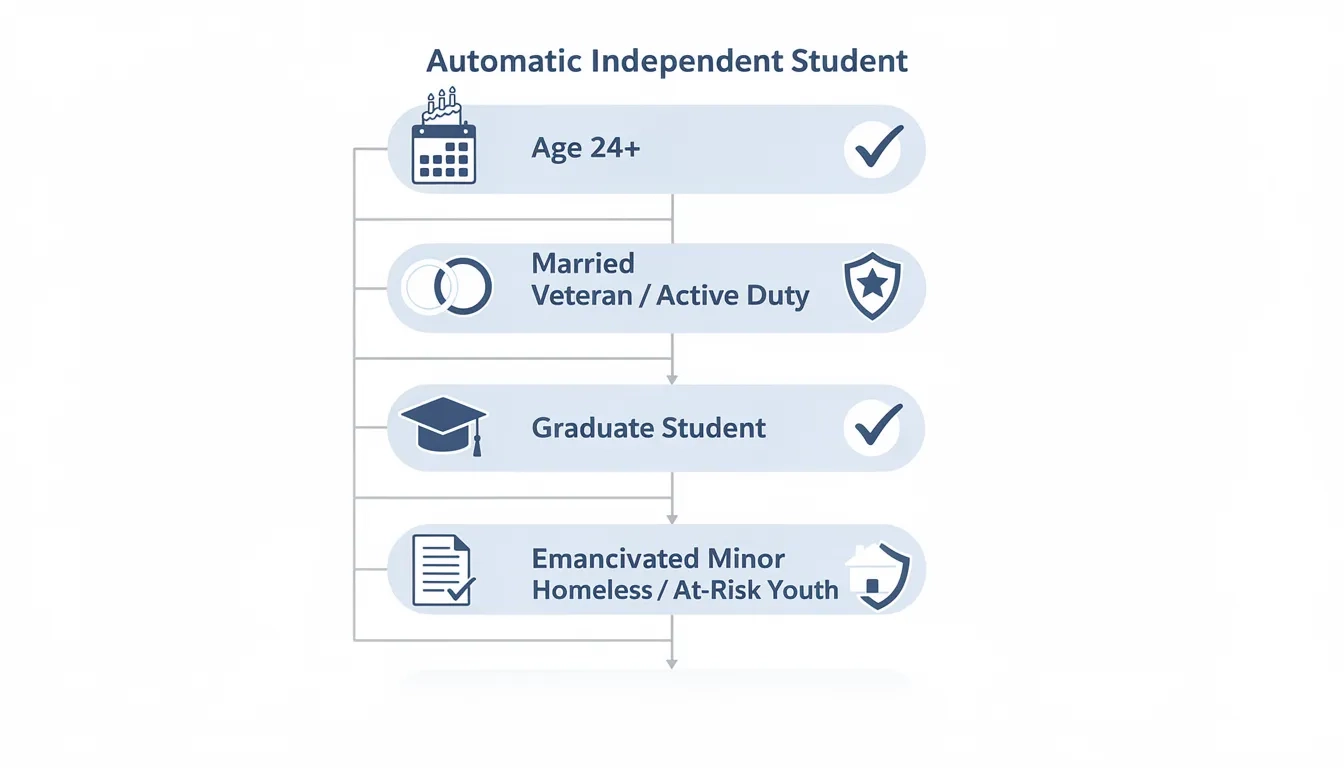
The fastest way to skip the parental information section is to already meet one of the Department of Education's automatic independence criteria. If any of these apply to you for the 2026-27 award year, you file as an independent — no parent questions, no appeals.
You automatically qualify if you:
- Were born before January 1, 2003 (age 24 or older by the end of the award year)
- Are currently married (not separated)
- Are a U.S. military veteran or active-duty service member
- Are enrolled in graduate or professional school
- Have children or other dependents you support (providing more than half their financial support)
- Were an emancipated minor, or are or were under legal guardianship
- Were a foster youth or ward of the court at any point after age 13
- Both of your parents are deceased
- Are currently an unaccompanied youth who is homeless or at risk of homelessness
The age threshold is by far the most common path. Lumina Foundation research shows 37% of college students are 25 or older, and the majority file independently without any issue.
But what if you're 20, estranged from your parents, and none of those boxes apply? That's where it gets complicated.
The Biggest Misconception About FAFSA Independence
Let me be direct: if your parents simply refuse to pay for college or won't provide their financial information, that does not qualify you for independent status. The Department of Education has been explicit about this for years, and financial aid offices enforce it consistently.
This trips up thousands of students every single year. A parent who says "you're on your own" — but is still alive and reachable — doesn't trigger an exception. Neither does a parent who stopped claiming you on their taxes, or one who cut off contact after high school.
"The federal government does not see it as they are not responsible...The federal government sees it very differently." — financial aid expert, Today's Students Coalition
The logic, frustrating as it is: the FAFSA measures parental ability to contribute, not willingness. If that ability exists on paper, the system expects parents to step up.
What this means practically: a dependent student whose parents refuse to cooperate can still file the FAFSA and receive unsubsidized Direct Loans. No grants, no subsidized loans until the situation is formally reviewed and documented — but something rather than nothing.
The Dependency Override: Unusual Circumstances That Actually Qualify
The dependency override is the formal mechanism that lets a financial aid administrator grant you independent status outside the automatic criteria. It's narrow on purpose.
Under the Higher Education Act (Sec. 480(d)(9)) and clarified further by the FAFSA Simplification Act, the following situations can qualify:
- Human trafficking (as defined under the Trafficking Victims Protection Act of 2000)
- Legally granted refugee or asylum status
- Parental abandonment or estrangement where parents' whereabouts are unknown
- An abusive family environment that makes contact unsafe
- Student or parental incarceration
The common thread is involuntary dissolution of the family relationship — not a strained one. Disagreements about money, parents who live far away, or long-term estrangement without a safety component generally won't meet the standard.
What Documentation You'll Need
Schools are required to retain supporting documentation for at least three years after your last enrollment. Building a strong file up front moves things faster.
Acceptable documentation can include:
- Written statements from welfare agencies, case workers, or service providers
- Court orders (incarceration records, guardianship orders, restraining orders)
- Statements from attorneys, TRIO/GEAR UP representatives, or guardians ad litem
- A documented interview with your financial aid administrator
- Utility bills or insurance records showing you live separately from your parents
- A dependency override determination from a prior institution (this carries over)
One thing working in your favor once you clear the hurdle: schools are required to presume your independent status in all subsequent years, unless you report changed circumstances or the school has conflicting information. You don't re-fight this every year.
The Unaccompanied Homeless Youth Pathway
This is a separate route from the dependency override, and it applies to more students than most people realize. The FAFSA Simplification Act explicitly distinguishes these two pathways — they're not interchangeable and shouldn't be confused.
You may qualify as an unaccompanied homeless youth if you are not in the physical custody of a parent or guardian, AND you are either:
- Homeless — lacking fixed, regular, and adequate housing
- Self-supporting and at risk of homelessness
The definition of "homeless" is broader than most students assume. You qualify if you're couch-surfing with friends, staying in an emergency shelter, living in a motel or car, or even living in a campus dorm specifically to avoid being on the street. Students facing eviction with no housing prospects also qualify under the "at risk" definition.
How to File Under This Pathway
- On the FAFSA, answer "Yes" to the homelessness question
- Select who has determined your unaccompanied status from the authorized list
- Complete the rest of the form as an independent student — no parent section required
Your school's financial aid office will then request documentation. This can be a written statement from you, or a documented interview with a financial aid administrator. One source is enough.
Who can provide official attestations:
| Authorized Source | Examples |
|---|---|
| School-based liaisons | McKinney-Vento liaisons, school counselors |
| Shelter/program directors | Emergency shelters, transitional housing programs, drop-in centers |
| Street outreach programs | Directors of federally recognized outreach programs |
| Education programs | TRIO or GEAR UP program directors |
| Financial aid staff | Financial aid administrators at your college |
SchoolHouse Connection maintains a homeless education liaison directory that can help you locate the right contact person for your area.
What Happens After You Submit: Provisional Status
Most guides skip over this part entirely. When you indicate unusual circumstances on the FAFSA, you don't get denied outright — you receive provisional independent status.
Your Student Aid Index (SAI) is calculated based on your information alone, and your application is flagged for review by the financial aid office. You can receive a preliminary aid offer during this window, though it will typically include only unsubsidized loans until the review concludes.
Federal rules require schools to complete their review "as quickly as practicable, but no later than 60 days after the student enrolls." Submitting your documentation early — ideally alongside or before enrollment paperwork — prevents gaps in your aid package and ensures grants are still available.
After review, one of three things happens: the school approves the override and upgrades your offer, denies it and asks for parental information, or determines you qualify as an unaccompanied homeless youth. If denied, you still have the option to appeal internally at the institution.
A Practical Decision Framework
If your situation doesn't fit neatly into any category, here's how to think through it:
Step 1: Check automatic criteria. Before anything else, confirm whether you already qualify as independent without an override. Many students who think they need an override actually qualify automatically.
Step 2: If you're homeless or at risk, use that pathway specifically. It's faster, requires less documentation, and carries a higher rate of approval than a full dependency override.
Step 3: If your situation involves abuse, abandonment, or trafficking, start building documentation immediately. Contact a campus TRIO program, school counselor, or social worker. The stronger your paper trail, the faster your review.
Step 4: File the FAFSA anyway, even without parental information. Filing puts you in the system and preserves your eligibility window. Provisional status is better than no status — and some federal grant programs are first-come, first-served, distributing aid as much as $23,847 per year until funds run out.
Step 5: Know your campus-specific resources. Many schools have dedicated staff for foster youth, homeless students, or students with unusual family circumstances. The University of California system's Guardian Scholars Program, for instance, provides specialized financial aid navigation for former foster youth at every campus.
Step 6: If parents simply won't cooperate, document the refusal through a third party (teacher, counselor, clergy member) and work with your financial aid office to record it officially. You may still access unsubsidized Direct Loans — up to $9,500 in your first year as a dependent — while exploring whether additional options apply.
A Note on the CSS Profile
Private colleges (and some public ones) use the College Board's CSS Profile alongside the FAFSA. The CSS Profile has its own independence criteria and, in some cases, offers a parental information waiver for students who can demonstrate parental unavailability or an abusive situation. Each institution handles this differently — there's no universal policy. If your target schools use the CSS Profile, contact their financial aid offices directly and ask about their specific waiver procedures before assuming the FAFSA rules apply there too.
Bottom Line
Filing FAFSA without parental information is genuinely possible for students who qualify — and genuinely difficult for those who don't. The system draws a hard line between "my parents are absent or unsafe" and "my parents won't cooperate," and knowing which side you're on determines your entire approach.
- Check automatic independence criteria first. Age 24+, veteran, married, or supporting dependents means you're already done — no override needed.
- Homeless or at risk? Use the unaccompanied youth pathway. It's the fastest route, and its definition of "homeless" includes couch-surfing and imminent eviction.
- Facing abuse, abandonment, or trafficking? Apply for a dependency override with third-party documentation. Once granted, it carries forward to future years.
- Parents refusing but otherwise reachable? File anyway, accept the unsubsidized loan offer, and document the refusal officially with your financial aid office.
- Don't wait to file. Even incomplete applications preserve your place in the aid queue. Provisional status while your case is reviewed beats sitting outside the system entirely.
Frequently Asked Questions
Can I file FAFSA without my parents' information if they simply refuse to help?
No — parental refusal alone doesn't qualify you for independent status or a dependency override. You can still file and receive unsubsidized Direct Loans (up to $9,500 in your first undergraduate year as a dependent), but you'll need to document the refusal and meet a specific exception to access grants or subsidized loans. Talk to your financial aid office about formally recording the situation.
What's the difference between a dependency override and unaccompanied homeless youth status?
They're distinct determinations and shouldn't be used interchangeably. A dependency override is granted case-by-case by a financial aid administrator based on qualifying unusual circumstances like parental abuse, abandonment, or trafficking. Unaccompanied homeless youth status is a self-reported designation on the FAFSA that gets confirmed through attestation from an authorized source. Both result in independent status, but the eligibility criteria, documentation process, and timelines differ significantly.
If I get a dependency override, do I have to reapply every year?
No. Under federal rules, schools must presume your independent status carries forward in subsequent award years unless you report changed circumstances or the institution has conflicting information. You won't need to restart the appeals process from scratch each year, which is a meaningful relief for students who've already gone through a difficult documentation process.
Does being kicked out of my parents' house count as grounds for an override?
Not automatically. Being asked to leave is a meaningful indicator of circumstances that may support an override, but the bar is typically involuntary dissolution of the family relationship — meaning you have no safe way to contact your parents, or their whereabouts are genuinely unknown. Talk to your school's financial aid administrator; they can assess your specific situation and let you know what documentation would help.
What if I aged out of foster care — do I need a dependency override?
No. Students who were in foster care or a ward of the court at any point after age 13 automatically qualify as independent — no override needed, no documentation process. Many colleges also have dedicated programs for former foster youth (like the California Community Colleges' Rising Scholars Network) that provide extra financial aid support and wraparound services beyond what the FAFSA alone unlocks.
Can my school deny a dependency override even if my documentation is solid?
Yes. Dependency overrides are professional judgment calls made by individual financial aid administrators, and each institution applies its own standards. If denied, ask about the school's internal appeal process. You can also request that another school consider your case — a prior override determination from a previous institution counts as acceptable documentation and can help establish your record at the new school.
Sources
- Special Cases | 2025-2026 Federal Student Aid Handbook
- How to Answer FAFSA Questions About Homelessness – SchoolHouse Connection
- The FAFSA Simplification Act: Youth Experiencing Homelessness and Youth with Experience in Foster Care – SchoolHouse Connection
- Federal Student Aid: Independent Student Status for FAFSA – FinAid
- Declare Yourself Independent for Financial Aid – Today's Students Coalition