Florida FAFSA Deadline 2026: The Complete State Aid Guide
Here's a number that gets students every year: the federal FAFSA deadline for the 2026-27 aid year is June 30, 2027. Florida's state deadline is May 15, 2026. That's not a typo — those are 13 months apart. Students who assume they have "plenty of time" sometimes discover they missed Florida's cutoff entirely, losing access to hundreds or even thousands of dollars in state grants. Filing strategy matters here as much as eligibility.
Florida's Two-Application System (and Why It Trips People Up)
Most states keep it simple: fill out the FAFSA and you're in the system. Florida does something different.
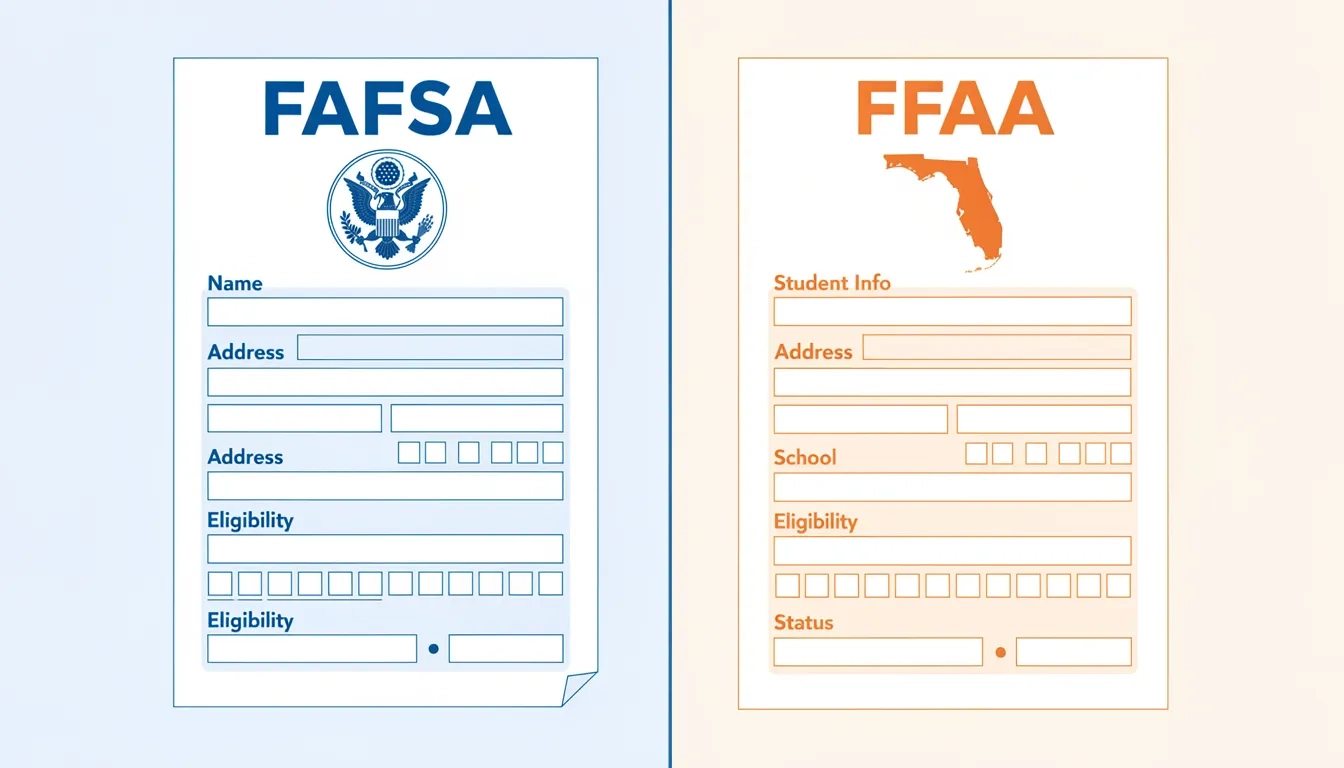
Florida runs two separate applications for two different pools of money. The FAFSA (filed at studentaid.gov) covers federal aid and Florida's need-based state grants. The FFAA — the Florida Financial Aid Application — is what gets you into Bright Futures, the state's flagship merit scholarship program. These are distinct forms filed on different websites with different deadlines.
The FFAA is submitted at floridastudentfinancialaidsg.org. Many students, and honestly a fair number of high school counselors, treat these as interchangeable. They're not.
Miss the FFAA and no amount of FAFSA completion will make you Bright Futures eligible. Miss the FAFSA and you won't qualify for FSAG need-based aid regardless of your financial situation. Both applications have to happen.
The May 15 Deadline That Actually Matters
Florida's FAFSA state processing deadline is May 15, 2026. That date is when your form needs to have been processed by the federal system — not just submitted. Processing typically takes 3 to 5 business days, which means your practical submission target is closer to May 8.
Filing early isn't just advice. Research consistently shows that students who submit the FAFSA within the first three months after the October 1 opening receive, on average, twice as many grants as students who file in the spring. Florida distributes some aid on a first-come, first-served basis before that May 15 cutoff, so earlier actually means more.
Here's how the key dates stack up for Florida students in the 2026-27 cycle:
| Deadline | Date | What It Covers |
|---|---|---|
| FAFSA opens | October 1, 2025 | 2026-27 aid year begins |
| Florida state FAFSA deadline | May 15, 2026 | FSAG and state need-based aid |
| Bright Futures test score cutoff | August 31, 2026 | Final SAT/ACT scores accepted |
| FFAA application deadline | August 31, 2026 | Bright Futures eligibility |
| Federal FAFSA deadline | June 30, 2027 | Federal aid only |
Florida Student Assistance Grant (FSAG)
FSAG is Florida's main need-based state grant, and it's available to undergraduate students whose FAFSA demonstrates financial need. No separate essay. No competitive selection process. If you're eligible and you file on time, you're in the pool.
Award amounts range from $200 to $2,610 per academic year, depending on state appropriations and demonstrated need. That's not enormous — but it stacks with Pell Grants and school-based aid, and over four years it adds up.
To qualify:
- U.S. citizen or eligible non-citizen
- Florida resident for at least one year prior to enrollment
- Enrolled in six or more degree-applicable credit hours per term
- Pursuing a first undergraduate degree
- FAFSA completed in full (partial submissions or errors can disqualify you)
That last point is the one that bites students. FSAG eligibility processing requires complete FAFSA data. A rejected or flagged FAFSA — even for something minor like a verification hold — can knock you out of consideration for that aid year.
Bright Futures: Florida's Flagship Merit Scholarship
Bright Futures is the reason Florida families should start planning in 9th grade, not senior spring. The program covers up to 100% of tuition and fees at Florida public universities and state colleges for qualifying students, and the gap between earning the top tier versus the second tier has real financial consequences.
At the University of Florida, the difference between Florida Academic Scholars (FAS) and Florida Medallion Scholars (FMS) works out to roughly $12,000 to $16,000 over four years. That's the cost of a semester or two — hinging on test scores and service hours accumulated during high school.
The Two Main Tiers
| Tier | Weighted GPA | SAT | ACT | Hours Required | Aid Coverage |
|---|---|---|---|---|---|
| Florida Academic Scholars (FAS) | 3.50 | 1330+ | 29+ | 100 (volunteer or paid) | 100% tuition & fees |
| Florida Medallion Scholars (FMS) | 3.00 | 1190+ | 24+ | 75 volunteer or 100 paid | 75% tuition & fees |
A few things about these requirements that regularly catch students off guard:
The GPA Florida uses is not the one on your transcript. Bright Futures calculates its own weighted GPA, adding 0.5 quality points for honors courses and 1.0 points for AP, IB, or dual enrollment. A student with a 3.35 transcript GPA might clear the 3.50 FAS threshold once weighting is applied. Run the calculation yourself before assuming you're out of range.
Superscoring is allowed, but only within the same test type. Florida will combine your best subscores from different SAT testing dates (or different ACT dates), but it won't mix SAT and ACT scores together. Pick your stronger exam and build on it.
Paid work hours count for FAS — a fact many families don't know. If a student worked 100 documented paid hours during grades 9-12, those satisfy the FAS hours requirement. Family tutoring and unpaid work for a family business don't qualify, but a legitimate part-time job does.
The Curriculum Requirement No One Talks About
Bright Futures checks coursework, not just GPA and test scores. Students need 16 specific credits:
- 4 English
- 4 Math (Algebra I level or above)
- 3 Natural Science (minimum 2 with labs)
- 3 Social Science
- 2 sequential credits in the same world language
Missing the sequential world language requirement disqualifies an otherwise strong applicant — and there's no workaround. Students who discover this in junior year with only one language credit completed are out of options for FAS. Check this box early.
Other Florida Aid Programs Worth Knowing
Effective Access to Student Education (EASE)
EASE is the most overlooked Florida grant, and it's specifically for students at private Florida colleges. If you're attending an eligible private non-profit institution — University of Tampa, Rollins College, Barry University, and others qualify — EASE provides approximately $2,000 per academic year. Over four years, that's $8,000 that many eligible students never claim because they didn't know the program existed.
EASE applications run through the institution's financial aid office, not OSFA directly. Florida residency certification (or a FAFSA with supporting documents) is required. Deadlines vary by school, so check with your institution's office early.
Benacquisto Scholarship
For National Merit Scholars and National Achievement Scholars, the Benacquisto Scholarship (named for former state senator Lizbeth Benacquisto) functions as a near-full ride at Florida public universities, covering tuition, fees, room, and board. The catch: you must designate a Florida public university as your first-choice institution when you're named a semifinalist. Miss that designation window and the award drops significantly. Maintenance requires a minimum 3.0 institutional GPA per term.
Scholarships for Children/Spouses of Deceased/Disabled Veterans (CSDDV)
Florida funds free tuition at public institutions for dependents of veterans who died or were disabled in service, and for POW/MIA families. CSDDV gets almost no attention compared to Bright Futures, but for eligible students it removes tuition costs entirely. Enrollment must include at least six credit hours per term to qualify.
A Realistic Timeline for Florida Students
For high school students targeting 2026-27 aid:
- October 1, 2025: FAFSA opens — file immediately, don't wait for spring
- November–January: If test scores aren't yet at your target tier, register for winter/spring SAT or ACT
- By May 8, 2026: Submit FAFSA (allows processing time before May 15 state deadline)
- Spring–Summer 2026: Final test sittings still count toward Bright Futures if scores report before August 31
- By August 31, 2026: Submit FFAA at floridastudentfinancialaidsg.org; final test score cutoff
For returning college students renewing aid:
- Bright Futures renewal requires a 2.75 GPA per semester at most Florida public institutions
- FSAG requires continued six-credit enrollment in a degree program
- File the FAFSA renewal each October 1 — set a recurring calendar reminder now
Mistakes That Cost Florida Students Real Money
A few patterns come up every single year:
- Treating FAFSA and FFAA as the same thing. They're filed on different websites and cover different programs.
- Waiting until March or April to file the FAFSA. The May 15 state deadline feels far away until it isn't, and first-come aid runs thin.
- Not running the Bright Futures weighted GPA calculation. Students with transcript GPAs below 3.50 sometimes qualify for FAS after accounting for advanced coursework.
- Skipping EASE at private colleges. $2,000 per year is $8,000 over four years left unclaimed.
- Forgetting the sequential world language requirement until it's too late to complete a second credit before graduation.
The honest assessment: Florida's financial aid system is more complicated than it needs to be. Two applications, different agencies, different deadlines, different eligibility rules — the students who navigate it best are the ones who map the whole system in 9th or 10th grade, not the ones who start researching in January of senior year.
Bottom Line
- File the FAFSA by May 15, 2026 (aim for May 8 to allow processing time). The federal June 30 deadline doesn't protect your state aid eligibility.
- Submit the FFAA separately at floridastudentfinancialaidsg.org for Bright Futures. FAFSA alone won't get you there.
- Calculate your Bright Futures weighted GPA yourself before assuming you're below the FAS threshold — honors and AP coursework can push you over 3.50 even if your transcript doesn't show it.
- Private college students: apply for EASE. It's roughly $2,000 per year that flies completely under the radar.
- The Bright Futures test score deadline is August 31, 2026 — summer test sittings still count if you're close to a tier cutoff.
Frequently Asked Questions
Does completing the FAFSA automatically apply me for Bright Futures?
No. The FAFSA and the Florida Financial Aid Application (FFAA) are separate systems. FAFSA makes you eligible for federal aid and Florida's need-based FSAG grant. Bright Futures requires the FFAA, filed at floridastudentfinancialaidsg.org. You need both applications for full state aid coverage.
What's the actual dollar difference between FAS and FMS?
FAS covers 100% of tuition and fees at Florida public institutions; FMS covers 75%. At the University of Florida, that gap runs approximately $12,000 to $16,000 over a four-year degree — before room and board. For students close to the FAS cutoff (SAT 1330, ACT 29), retaking tests one more time is often worth the effort.
Can I still qualify for Bright Futures after high school graduation?
Yes, with limits. The test score deadline extends to August 31, 2026, so students can take the SAT or ACT during the summer after graduation and have those scores count. The FFAA deadline also runs to August 31. You cannot, however, go back and add service hours after graduation — those must be completed during grades 9 through 12.
Is the May 15 Florida FAFSA deadline for submission or processing?
Processing. The federal system takes 3 to 5 business days to process a submitted FAFSA. If you submit on May 14, there's a real chance it won't be processed by May 15. Treat May 8 or 9 as your personal hard deadline, and October or November as your smart target.
My family had a major financial change after we filed — what can we do?
Contact your school's financial aid office and request a Professional Judgment review (sometimes called a Special Circumstances appeal). Financial aid administrators have authority to adjust your aid package based on documented changes — job loss, medical costs, divorce, or other significant events. It's not guaranteed, but it's the right channel, and it costs nothing to ask.
Sources
- Florida Bright Futures Scholarship Requirements 2026 | InLighten
- Bright Futures Requirements 2026 Florida: GPA, SAT & Hours | LearnHaus
- Florida Aid Programs | University of Miami Financial Aid
- 2026-27 Financial Aid and FAFSA State Deadlines | Fastweb
- Important FAFSA Deadlines for 2025-2026 and 2026-2027 | Saving for College