Free Community College by State: The Promise Program Guide
In May 2024, Tennessee enrolled its 150,000th student through the Tennessee Promise — exactly a decade after it launched as the first statewide free community college program in the country. Thirty-six states have followed with their own versions. And yet, depending on which state you live in and how much your family earns, "free community college" might mean everything or almost nothing.
The gap between the phrase and the reality is where most students get tripped up.
The Two Types of "Free" — and Why It Changes Everything
Before looking at any specific state, you need to understand first-dollar versus last-dollar scholarships. This one distinction determines whether a low-income student actually benefits from a promise program — or gets nothing.
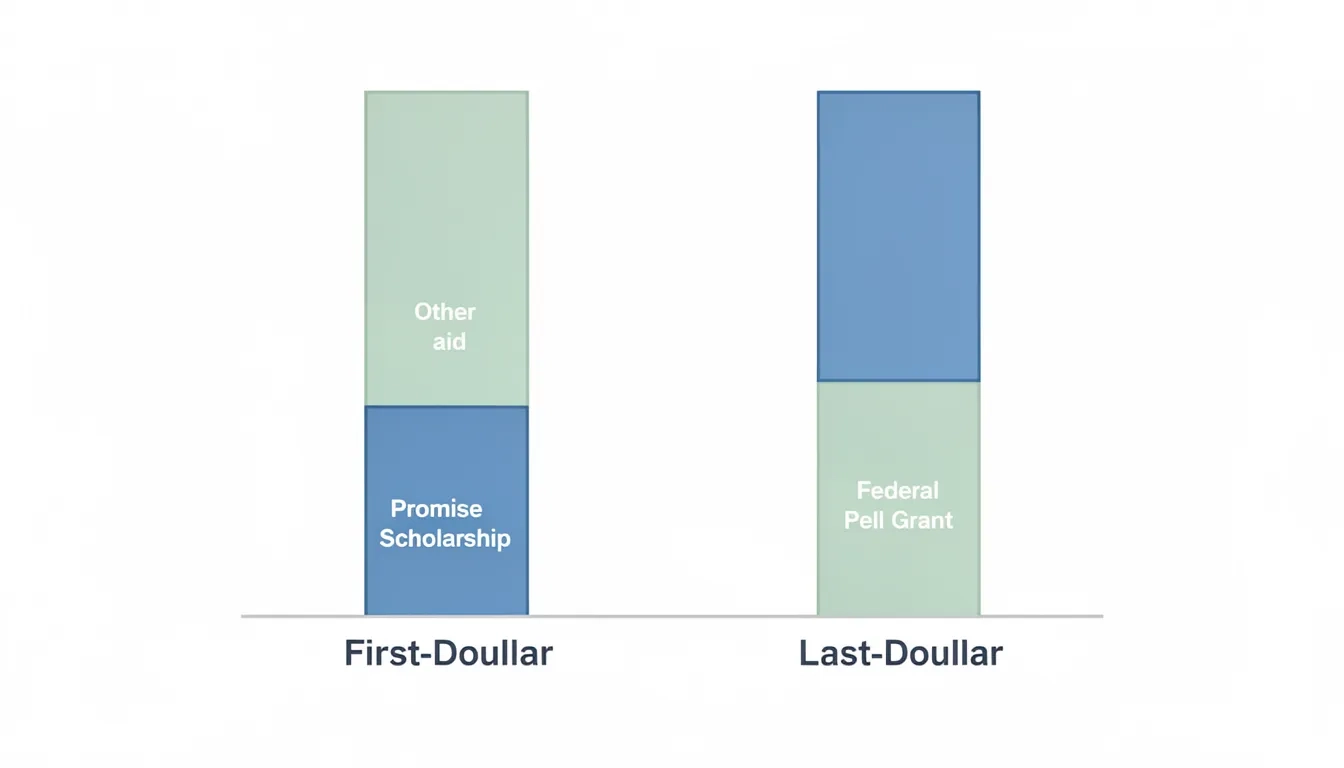
A last-dollar scholarship pays what's left after all other aid is applied. Your federal Pell Grant (worth up to $7,395 for 2025-2026) gets applied first. If it already covers your tuition, the state promise program pays you zero. The scholarship only activates when your Pell Grant runs short.
A first-dollar scholarship covers tuition upfront, regardless of what other aid you have. The student keeps their Pell Grant intact for rent, groceries, and textbooks.
Most state promise programs are last-dollar. Oregon's Higher Education Coordination Commission analyzed its own program and found that 70% of Oregon Promise Grant funds were flowing to students with the least financial need — because those students had smaller Pell Grants and left more tuition uncovered.
"When it comes to increasing enrollment, increasing retention, increasing completion, we're not seeing, in our own data, that the program is having that effect." — Kyle Thomas, HECC Director of Legislative and Policy Affairs, May 2026
This is the elephant in the room with free college policy. A program can look universal on paper while quietly benefiting middle-income students far more than low-income ones.
Universal Programs: No Income Limit
These are the cleanest — enroll, meet the requirements, tuition is covered regardless of your family's finances.
| State | Program | Scope | Key Conditions |
|---|---|---|---|
| Tennessee | Tennessee Promise | Community & technical colleges | 2.0 GPA, 8 hrs community service/semester, mentor meetings |
| Massachusetts | MassEducate | All 15 public community colleges | FAFSA required, no prior bachelor's degree |
| Rhode Island | Rhode Island Promise | Community College of Rhode Island | HS grad within 18 months, full-time enrollment |
| Nevada | Nevada Promise Scholarship | Nevada community colleges | Recent HS grad, 6 hrs community service, 2.0 GPA |
| Arkansas | Arkansas Future Grant | Public 2-year colleges and tech institutes | High-demand fields only (STEM, healthcare, business), 2.5 GPA |
Massachusetts went furthest when it launched MassEducate in 2024 — free community college for all residents regardless of age or income, with an additional allowance up to $2,000 for expenses. Returning adults with no bachelor's degree are fully included. No career-field restrictions.
That's a meaningfully different commitment than most states offer.
Income-Based Programs: The Larger Group
Most states fall here. The programs are real, but eligibility depends on household income.
| State | Program | Income Limit | Notable Detail |
|---|---|---|---|
| New York | Excelsior Scholarship | $125,000 household | 30 credits/year required; post-grad residency commitment |
| Colorado | Colorado Promise | $90,000 family income | Launched Fall 2024; covers 4-year public schools too |
| Minnesota | North Star Promise | $80,000 | Covers state universities and colleges, not only community colleges |
| New Jersey | Community College Opportunity Grant | $65,000 AGI | Part-time students explicitly eligible |
| Wisconsin | Wisconsin Fast Forward | $55,000 | Two-year colleges |
| Maryland | Community College Promise Scholarship | Varies | Up to $5,000 last-dollar; FAFSA required |
New York's Excelsior Scholarship has one of the most generous income ceilings, but the post-graduation residency requirement is a real catch. You must live in New York for as many years as you received the award. Leave the state before that window closes and the scholarship converts to a loan — retroactively.
Colorado is worth watching. It only launched in Fall 2024, extended coverage to four-year public institutions, and applies to families earning under $90,000. Early enrollment data isn't available yet, but the scope is unusually broad for an income-tested program.
Workforce-Focused Scholarships: A Third Category
A growing set of states don't offer broad free community college but do cover tuition for specific high-demand careers. If you're training in the right field, these can be as generous as any universal program.
- Georgia HOPE Career Grant covers tuition for programs in healthcare, transportation, technology, and manufacturing
- Kentucky Work Ready Scholarship targets healthcare, IT, and skilled trades
- South Dakota Build Dakota focuses on agriculture, healthcare, and technology
- Virginia G3 (Get Skilled, Get a Job, Give Back) covers tuition for low-income students in workforce programs and adds up to $900/semester for childcare and transportation
Virginia's childcare and transportation stipend deserves attention. It's rare, and it targets the actual barrier that stops adult students — not the tuition, but the logistics of getting to class while working and raising kids.
The Fine Print That Trips People Up
Residency requirements are strict and often overlooked. Most programs require 1-3 years of state residency before enrollment. If you moved to Colorado six months ago, you likely won't qualify for Colorado Promise until your second year.
Enrollment status is another filter that quietly eliminates most community college students. Many programs require full-time enrollment (12+ credits per semester). The U.S. Department of Education estimates roughly 62% of community college students attend part-time — usually because they're working or caregiving. Connecticut's PACT program and New Jersey's Community College Opportunity Grant are uncommon exceptions that explicitly allow part-time enrollment.
Prior degree restrictions catch returning adults by surprise. Massachusetts, like several states, won't cover community college tuition if you already hold a bachelor's degree. A career-changer with a four-year credential trying to retrain as a medical assistant won't qualify in most states.
Continuing eligibility is often more demanding than initial eligibility. Tennessee requires both a 2.0 GPA and 8 community service hours every single semester. Miss the service requirement while maintaining a 3.5 GPA? You lose the funding anyway.
"Free Tuition" Still Leaves a $16,040 Gap
Tuition at public community colleges averages $3,780/year in-district — that's what promise programs cover. The College Board's 2024 data puts total annual attendance costs for off-campus community college students at approximately $19,820, once you add housing, food, transportation, books, and fees.
The gap is $16,040. For a student working 30 hours a week to cover rent, that gap is what ends enrollment in month four — not academic failure.
Some programs are starting to acknowledge this. Virginia's G3 includes the childcare and transportation stipend. Hawaii's program covers textbooks and transportation alongside tuition. California's free tuition program coexists with substantial basic needs grants at individual colleges.
But most programs stop at tuition. The framing of "free college" can set students up for a genuine shock when they discover what covered tuition actually represents as a share of total college cost.
Ten Years of Tennessee: What the Data Shows
Tennessee Promise launched in 2014 and is the most studied free community college program in the country. The headline numbers from the Class of 2025 application cycle are strong: over 66,000 seniors applied — the largest pool in program history. First-to-second-semester retention hit 83.8% for the 2022-23 cohort, an all-time high.
What the research complicates: early peer-reviewed analysis found that Tennessee Promise primarily increased community college enrollment among students who would otherwise have attended four-year institutions, not among students who would have skipped college entirely. The college-going rate among the lowest-income quartile of Tennessee high school graduates did improve, but the biggest numerical gains came from middle-income families.
The community service requirement turned out to be an accidental win. Originally seen as bureaucratic friction, it appears to have kept students engaged with their communities and contributed to the higher retention rates. Eight hours of volunteering a semester is a small ask — and the data suggests it pays off in ways that aren't obvious from the outside.
Oregon's Warning: When Program Design Defeats the Goal
Oregon's Promise Grant launched in 2016 with $40 million in annual funding. By May 2026, Oregon's Higher Education Coordination Commission had drafted a proposal to discontinue it entirely — redirecting the budget to the Oregon Opportunity Grant, the state's larger needs-based program with $329 million in funding.
The problem was structural, not attitudinal. Because Oregon Promise is last-dollar, it mainly activated for students whose Pell Grants didn't quite cover tuition. Wealthier students. Meanwhile, community college enrollment among recent Oregon high school graduates has fallen below pre-2016 levels despite a decade of the program running.
The money wasn't reaching the people who needed it most. No change can happen without state legislative approval, but the HECC proposal is a serious signal that universal, last-dollar programs can underperform precisely because of their universality.
Oregon's situation is the clearest real-world case that program existence isn't enough. Design matters as much as intent.
How to Find and Apply for Your State's Program
- Start at your state's higher education commission website. Search "[your state] higher education commission" plus "promise scholarship." This gets you to the primary source, not an aggregator.
- File the FAFSA first. Every state promise program requires it. Filing early — ideally in January or February before a fall semester — protects your eligibility window. Deadlines vary, but late FAFSA submissions have cost students thousands.
- Check enrollment status requirements immediately. If you can only attend part-time, rule out full-time-only programs before you invest more research time. It will narrow your options fast.
- Ask a financial aid counselor about stacking. Some promise scholarships can be combined with institutional grants or employer tuition assistance. Others prohibit it. A 15-minute phone call typically clarifies this faster than an hour of searching.
- Read the continuing eligibility rules before you enroll. Know the GPA floor, service hour requirements, minimum credit load, and renewal deadlines before your first semester — not after your first warning notice.
Bottom Line
- First-dollar programs beat last-dollar programs for low-income students, even when last-dollar programs look universal. Oregon is proof. Check which type your state uses before counting on it.
- Tennessee, Massachusetts, and Rhode Island offer the most accessible universal programs — no income cap, broad scope, no career-field restrictions.
- "Free tuition" covers around $3,780/year. Total attendance costs run closer to $19,820. Plan for the gap.
- Part-time students should look specifically at Connecticut PACT and New Jersey's Community College Opportunity Grant — they're among the few programs that don't require full-time enrollment.
- File the FAFSA early. Every single state program requires it, and early filing is the one step that protects eligibility across the board.
Frequently Asked Questions
Is community college actually free if I qualify for a promise program?
Tuition is covered — which averages around $3,780/year at in-district community colleges. But total attendance costs (housing, food, transportation, books, fees) run closer to $19,820/year. Promise programs typically cover the tuition slice, not the full bill. A few states like Virginia and Hawaii include small stipends for other expenses, but most don't.
Do I have to be a recent high school graduate to qualify?
It depends on the state. Rhode Island Promise and Nevada's program require graduating within 18 months. Tennessee and Massachusetts have no age restriction. Several states explicitly serve adult learners. If you're a returning adult, Massachusetts MassEducate and Tennessee Promise are your most accessible options — but check your own state's rules directly, since this varies significantly.
What's the real difference between last-dollar and first-dollar scholarships?
A last-dollar scholarship pays after federal aid is applied. If your Pell Grant already covers your tuition, a last-dollar program gives you nothing extra. A first-dollar scholarship covers tuition regardless of other aid — you keep your Pell Grant for living expenses. Most state programs are last-dollar, which is why they help middle-income students more than the poorest students, despite looking universal.
Can I use a promise scholarship at a four-year university?
Usually no. Most are restricted to community colleges or two-year technical schools. Notable exceptions: Colorado's Promise extended to public four-year schools in Fall 2024, and New York's Excelsior Scholarship covers CUNY and SUNY four-year campuses. Tennessee Promise, Rhode Island Promise, and the majority of state programs are community college only.
What happens if I drop below the GPA requirement?
Most programs allow reinstatement after a probationary semester if you bring your GPA back up. Tennessee's reinstatement process is well-documented — one semester on probation, then restored eligibility with satisfactory grades. But reinstatement timelines and conditions differ by state. Read the renewal requirements for your specific program before you need them, not during a crisis.
Do promise scholarships reduce my Pell Grant or other federal aid?
For last-dollar programs, your Pell Grant is applied first — the promise scholarship doesn't reduce it. For first-dollar programs, tuition is paid before Pell is applied, which leaves your Pell Grant available for other costs. Either way, filing the FAFSA is required and your federal aid package is calculated the same way. The scholarship interacts with it; it doesn't reduce it.
Sources
- Is Community College Free? 50 States with Free Tuition in 2025 | CollegeVine Blog
- Oregon's tuition-free community college aid program could be on its last legs | OPB
- Tennessee Promise Marks a Decade of Success | Tennessee Higher Education Commission
- Tennessee Promise Record-Breaking Class of 2025 | THEC
- Which States Offer Tuition-Free Community College? | Scholarships360
- Free College Programs by State 2026 | DegreeCalc