Fresh Start Program for Defaulted Loans: What Happened and What to Do Now
Seven and a half million Americans had a rare shot to erase a federal student loan default from their credit history — no court order required, no lengthy repayment history to rebuild first. The window stayed open for over two years. When it finally closed at 2:59 a.m. on October 2, 2024, an unknown number of eligible borrowers had simply let it pass. And now, as of January 2026, wage garnishment notices are going out in the mail.
What the Fresh Start Program Actually Was
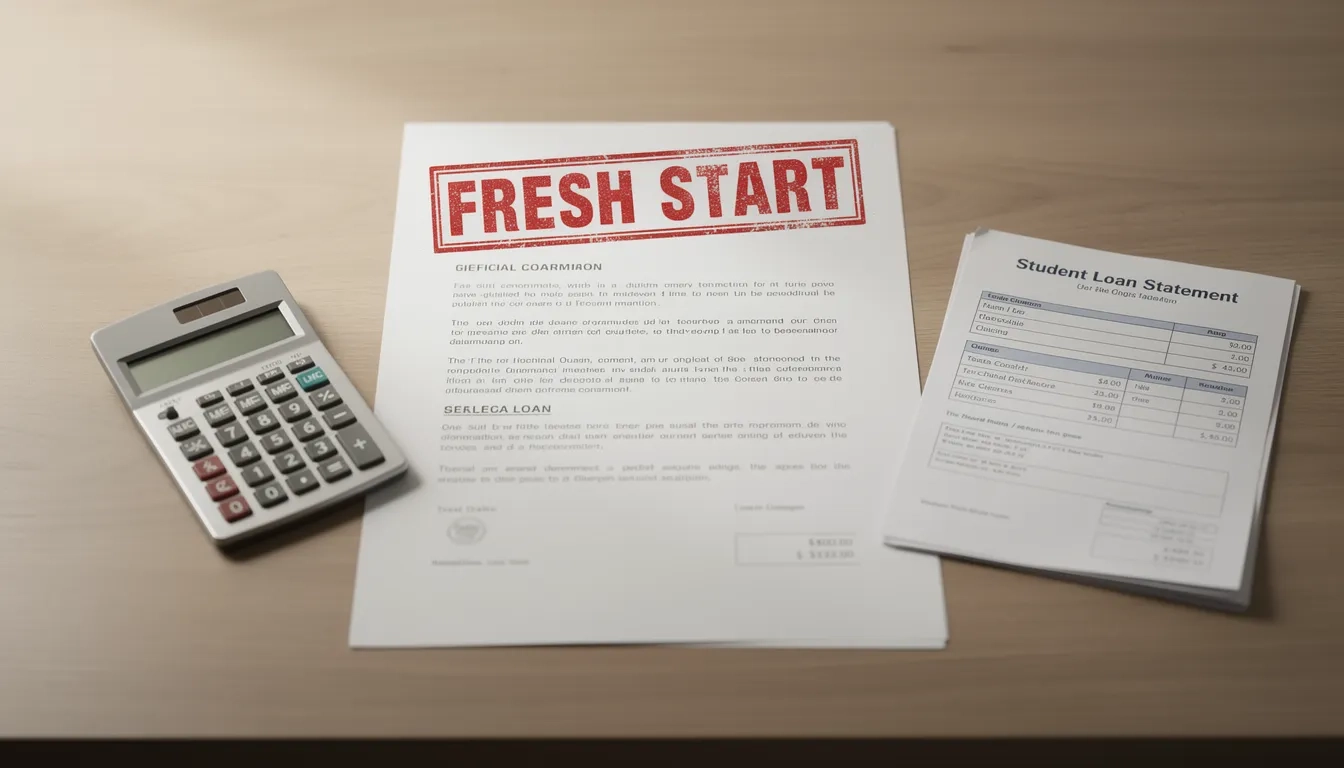
Fresh Start was not loan forgiveness. The Department of Education didn't cancel balances or reduce what borrowers owed. What it did was procedurally simpler — and genuinely more useful for everyday financial life than most borrowers realized.
Announced in April 2022, Fresh Start let borrowers with pre-pandemic federal student loan defaults transfer their loans to a non-default servicer, with the default record automatically removed from their credit report as part of the transfer. The "in default" status on their account switched to "in repayment." The stain on their credit file disappeared.
The program ran alongside the extended pandemic payment pause. The logic was that millions of borrowers had defaulted before March 13, 2020, and were frozen out of federal student aid, income-driven repayment plans, and in many cases, government-backed mortgages. Fresh Start was the mechanism to bring them back in. One time. Temporarily.
Who Was Eligible
The eligibility boundary was a hard date. If your federal student loans defaulted before March 13, 2020, you likely qualified. Loans that fell into default after that date — including during the repayment pause — were not covered.
A lot of confusion circulated around this. Borrowers who defaulted in 2022 or 2023 sometimes assumed they were included. They weren't.
Here's how eligibility broke down:
- Eligible: Defaulted Direct Loans or FFEL loans held by the Department of Education, with default before March 13, 2020
- Eligible: Borrowers already partway through a loan rehabilitation agreement
- Not eligible: Loans that defaulted after March 13, 2020
- Not eligible: Private student loans (Fresh Start was federal-only)
- Not eligible: Perkins Loans held by the original school, rather than the Department
If you weren't sure where your loans stood, the Default Resolution Group (1-800-621-3115) was the place to start.
What It Actually Did for Borrowers
This is where Fresh Start genuinely outpaced every other option. Standard loan rehabilitation takes nine months and removes the default from your credit. Consolidation is faster but leaves the default mark on your file. Fresh Start did what rehabilitation does — wiped the default from your credit report — with significantly less friction.
The Consumer Financial Protection Bureau tracked the credit impact and found that borrowers affected by the Fresh Start changes saw a median credit score increase of more than 50 points. For someone sitting at a 590 score, that 50-point gain is the difference between qualifying for a mortgage and getting declined, or between a 9% car loan rate and something manageable.
Beyond credit, Fresh Start unlocked several things at once:
- Federal student aid eligibility restored, including Pell Grants and Federal Work-Study funds — critical for borrowers who wanted to return to school
- Access to income-driven repayment plans, including the SAVE plan (Saving on a Valuable Education), which can produce $0 monthly payments for borrowers with low incomes while still counting toward eventual forgiveness
- Access to deferment and forbearance, giving borrowers flexibility if their financial situation was still unstable
Borrowers who successfully enrolled in Fresh Start didn't just fix a credit problem. They regained access to almost every federal financial tool that default had locked them out of — sometimes for years.
How Enrollment Worked
Enrollment required an active request. The program didn't automatically apply to eligible borrowers; you had to ask for it. But the process itself was simple by government standards.
Three paths existed for enrollment:
- Online — Log in at myeddebt.ed.gov and request the Fresh Start transfer
- By phone — Call the Default Resolution Group at 1-800-621-3115
- By mail — Submit a written request to the Default Resolution Group at the Department of Education
Once a borrower requested the transfer, the Department moved the loans to a non-default servicer. The credit bureau update followed from there. One tricky part (and this caught people off guard): the transfer did not automatically enroll borrowers in a repayment plan. You had to take a second step and contact your new servicer to actually set up payments. People who did the first step and stopped were technically out of default but not in active repayment.
The Window Slammed Shut
Fresh Start enrollment ended permanently. The Department briefly extended the deadline on the night of September 30, 2024, to give last-minute applicants a few more hours. That gave borrowers until 2:59 a.m. ET on October 2, 2024. After that, the program closed with no announcement of any future reopening.
The January 2025 update from Federal Student Aid formalized the post-Fresh Start rules for schools: no Title IV aid may be awarded under the Fresh Start initiative for any enrollment period beginning after October 2, 2024. Borrowers with unresolved defaults must now use the standard rehabilitation or consolidation process before receiving new federal aid. Institutions were notified, and the exception is gone.
Then the collections side of the equation shifted. In December 2025, the Department of Education announced it would resume involuntary collections on defaulted loans. According to NPR, the first wage garnishment notices went out to approximately 1,000 borrowers during the week of January 7, 2026. Small number to start. The rollout will grow.
What Defaulted Borrowers Face Now
The federal government's debt collection powers are unlike anything a private creditor holds. It does not need to sue you and win a judgment. It can garnish up to 15 percent of your disposable pay through administrative wage garnishment, and your employer is legally required to comply. It can seize your federal tax refund before it ever reaches your bank account. It can offset Social Security benefits. None of this requires a court.
Default happens at 270 days past due. That's nine months of missed or $0 payments (outside an official plan). If you're not sure where your loans are, check StudentAid.gov now, before a garnishment notice tells you.
My honest assessment: borrowers who could have enrolled in Fresh Start and didn't are now in a materially harder position. That's not a judgment — the program communications were inconsistent and confusing — but the practical reality is that the path forward requires more time, more payments, and still may not fully repair your credit the way Fresh Start would have.
Your Options Now: Rehabilitation vs. Consolidation
Two real paths remain out of federal student loan default. Neither is as fast or as clean as Fresh Start was, but both work.
Loan Rehabilitation
Rehabilitation requires nine voluntary, on-time monthly payments over a period of no more than ten consecutive months. Your payment is calculated at 15% of your annual discretionary income divided by 12, though you can negotiate a lower amount if that's genuinely unaffordable.
Once all nine payments are complete, the default is removed from your credit report at all three major bureaus (though late payment records before the default may still appear). You regain access to IDR plans, federal aid, and forgiveness programs including Public Service Loan Forgiveness. Collections stop once you're enrolled and making qualifying payments.
One hard limit: each loan can only be rehabilitated once. Default again after rehabilitating, and that option is permanently off the table for that loan.
Direct Consolidation
Consolidation combines your defaulted loans into a new Direct Consolidation Loan. The new loan is immediately current. No nine-month waiting period. For borrowers who receive a garnishment notice and need to act fast, consolidation can resolve the default status in a matter of weeks.
The tradeoff is credit reporting. Consolidation marks the old defaulted loan as "paid in full" (or "paid in full through consolidation"), but does not remove the original default record. The default stays visible on your credit history.
Here's a side-by-side comparison:
| Rehabilitation | Direct Consolidation | |
|---|---|---|
| Time to complete | 9–10 months | A few weeks |
| Removes default from credit | Yes | No |
| Stops collections | After first qualifying payment | Once consolidation is complete |
| Access to IDR plans after | Yes | Yes |
| Can be used multiple times | No (once per loan) | Yes |
| Available after garnishment order | Yes | No |
Acting Before a Garnishment Notice Arrives
If you receive a garnishment notice, you have 30 days to respond before garnishment begins. During that window, you can object on specific grounds (financial hardship, discharge eligibility, involuntary unemployment in the past 12 months) or enter into a rehabilitation agreement. If your first rehabilitation payment is made within the 30-day objection window, garnishment is paused.
Once a formal garnishment order is in place, Direct Consolidation is no longer available. Rehabilitation becomes your only option. That 30-day window sounds like enough time, but it disappears fast when you're also managing work, family, and figuring out who to call.
Contact the Default Resolution Group at 1-800-621-3115 or log in at myeddebt.ed.gov to check your status and start either process. Don't wait for the letter.
Bottom Line
- Fresh Start is closed for good. There's no petition, no extension, no workaround. If you missed it, you're working with rehabilitation or consolidation now.
- Wage garnishment is active. The Department of Education began sending notices in January 2026. The government can take 15% of your paycheck without a court order, and it is using that authority.
- Rehabilitation beats consolidation if credit repair matters to you. Nine months is slow, but it's the only route that removes the default notation from your credit file entirely.
- If a garnishment notice arrives, act within 30 days. Starting rehabilitation in that window pauses garnishment. Waiting longer means the government's timeline becomes yours.
- Check your status now at StudentAid.gov. You may be closer to the 270-day default threshold than you realize, and knowing your status costs nothing.
The window that Fresh Start offered was genuinely unusual — the kind of opportunity that rarely shows up in federal student loan policy. It's gone. What's left are slower, more friction-heavy paths, but they still lead to the same destination: loans restored to good standing, collections stopped, and the door to IDR and forgiveness programs opened back up.
Frequently Asked Questions
Is the Fresh Start program still accepting applications in 2026?
No. Enrollment closed permanently at 2:59 a.m. ET on October 2, 2024. The Department of Education extended the deadline briefly on September 30, 2024, but that extension has passed and no further extensions have been announced. The program is fully closed.
Does loan rehabilitation actually remove the default from my credit report?
Yes. Completing nine qualifying rehabilitation payments triggers a request to all three major credit bureaus to remove the default notation. Any late payment records from before the default may still appear, but the default itself disappears. Direct Consolidation, by contrast, marks the old loan as "paid" but leaves the default record on your history — a meaningful difference if you're trying to buy a home or qualify for financing.
Can the federal government garnish my wages without taking me to court first?
Yes, and this is one of the more startling aspects of federal student loan default. Unlike private creditors, the Department of Education can garnish up to 15% of your disposable earnings through administrative wage garnishment without obtaining a court judgment. It can also intercept federal tax refunds and offset Social Security benefits through the same administrative process. Private lenders have none of these powers without a court order.
I defaulted in 2022. Was I ever eligible for Fresh Start?
No. Fresh Start only applied to borrowers whose federal loans defaulted before March 13, 2020, the date the pandemic payment pause began. Loans that fell into default after that date — including during and after the pause — were not eligible. If you defaulted in 2021, 2022, or later, rehabilitation or consolidation have always been your options.
What's the real difference between a $0 income-driven payment and just not paying?
This is a myth worth clearing up directly. A $0 payment under an income-driven repayment plan is an official, documented qualifying payment. It counts toward PSLF (Public Service Loan Forgiveness) and toward the 20- or 25-year forgiveness clock on standard IDR plans. Simply not paying is delinquency, which leads to default after 270 days. The two situations look identical on a monthly cash flow statement but have completely opposite long-term consequences.
I already received a garnishment notice. What do I do right now?
Call the Default Resolution Group at 1-800-621-3115 immediately. You have 30 days from the notice date to object or to enter a rehabilitation agreement before garnishment begins. If you make your first rehabilitation payment within that 30-day window, garnishment is paused. Note that once an active garnishment order has been formally issued, Direct Consolidation is no longer available — rehabilitation is the only remaining path to resolve the default.
Sources
- A Fresh Start for Federal Student Loan Borrowers in Default - Federal Student Aid
- End of Fresh Start Initiative Reinstates Limited Title IV Eligibility (January 2025 Update) - College Aid Services
- Fresh Start Program Changes Followed by Increased Credit Scores - Consumer Financial Protection Bureau
- Fresh Start Program for Student Loans Ended — What to Do Now - LendEDU
- The Department of Education is Starting to Garnish Wages - Student Loan Borrowers Assistance
- Student Loan Borrowers in Default Will Soon Risk Wage Garnishment - NPR