Swarthmore College: Admissions, Rankings, and Student Life
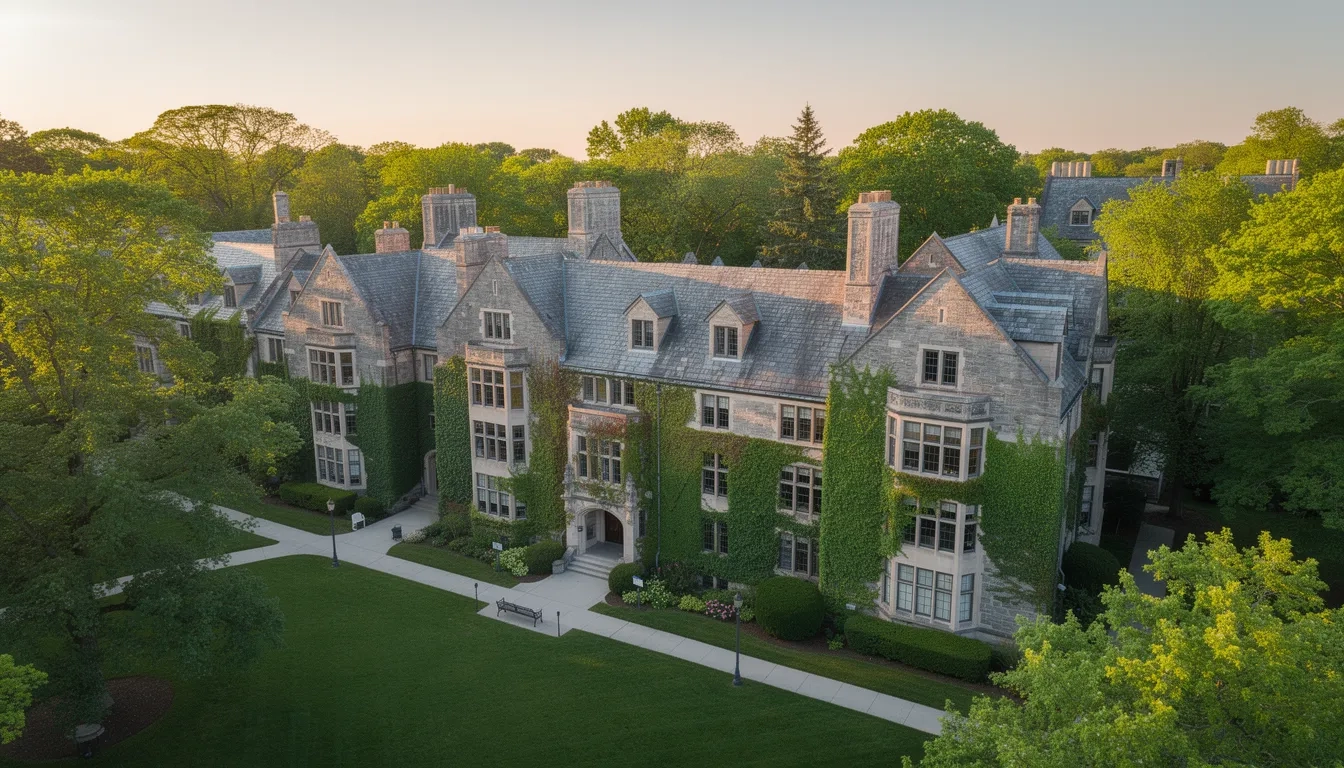
In the spring of 2026, Swarthmore College sent acceptance letters to 977 applicants out of 12,995 who tried. That's a 7.52% acceptance rate — and the school pulled it off without a medical center, a law school, or a football team to pad enrollment with recruited athletes. Just 1,623 undergraduates, a 425-acre campus outside Philadelphia, and an academic tradition that has produced six Nobel Prize winners and thirteen MacArthur Fellows. The question isn't whether Swarthmore is impressive. It's whether it's the right fit for you — and if so, how you actually get in.
The Numbers: Just How Selective Is Swarthmore?
Swarthmore's acceptance rate has been tightening for the better part of two decades. The Class of 2029 data makes it concrete: 12,995 applicants, 977 admitted, nine out of ten turned away.
What makes those figures more striking is who's in the pool. Of admitted students who reported class rank, 93% placed in the top 10% of their graduating class. These aren't borderline applicants — they're the top students at competitive high schools, and even among them, Swarthmore says no to the vast majority.
Transfer students face a slightly different equation. In the same cycle, 42 of 421 transfer applicants were admitted, a 9.98% rate that's meaningfully more accessible than the first-year number, though still demanding.
| Application Type | Applicants | Admitted | Rate |
|---|---|---|---|
| First-Year (Class of 2029) | 12,995 | 977 | 7.52% |
| Early Decision (Class of 2030) | 1,249 | 231 | 18.49% |
| Transfer (Class of 2029) | 421 | 42 | 9.98% |
No single test score or GPA guarantees admission. But a student in the top 5% of their class, with a genuinely rigorous course load and something specific to say in their essays, has a real shot.
Where Swarthmore Stands in the Rankings
US News ranked Swarthmore #4 among National Liberal Arts Colleges in its 2026 edition. The school also landed #4 in Best Value Schools — a combination that signals both academic prestige and meaningful financial commitment to students.
The $2.84 billion endowment (as of 2025) underpins both designations. That figure represents the eleventh-largest endowment per undergraduate in the entire country — a staggering resource base for a school with fewer than 1,700 students.
| School | US News Rank (Liberal Arts) | Est. Endowment | Undergrads |
|---|---|---|---|
| Williams College | #1 | ~$4.3B | ~2,100 |
| Amherst College | #2 | ~$4.1B | ~1,900 |
| Pomona College | #3 | ~$3.3B | ~1,700 |
| Swarthmore College | #4 | $2.84B | ~1,623 |
| Wellesley College | #5 | ~$2.9B | ~2,400 |
Swarthmore also participates in the Tri-College Consortium with Haverford College and Bryn Mawr College, all within a short drive of each other in suburban Philadelphia. Students can take courses at all three institutions, which stretches the academic catalog well beyond what a 1,623-student school would typically support on its own.
Applying Smart: Early Decision and What Actually Matters
The single clearest strategic lever for serious Swarthmore applicants is Early Decision. The 18.49% ED acceptance rate for the Class of 2030 is more than double the 7.52% overall. Schools reward demonstrated commitment, and Swarthmore is no exception.
ED is binding, though. If admitted, you go. That only makes sense if Swarthmore is genuinely your first choice and you're confident the financial aid package will work. Applying ED purely to boost odds while planning to compare offers from multiple schools is a strategy that tends to backfire — and admissions officers have seen that play before.
What Swarthmore actually looks for, based on its stated priorities and the admitted class profile:
- Maximum course rigor: Students who pushed their high school curriculum as far as it allowed — AP, IB, dual enrollment, whatever was on offer.
- Cross-disciplinary curiosity: The college's unusual engineering program within a liberal arts framework is a signal. Students who move comfortably across disciplines fit better here than those optimized for a single subject.
- A collaborative mindset: Swarthmore was founded in 1864 by Hicksite Quaker leaders including Deborah Fisher Wharton and Joseph Wharton, and that heritage of community-oriented learning still shapes what admissions officers value. Competitive-for-competition's-sake doesn't land well.
Essays carry real weight at a school this small. The admissions office is genuinely trying to figure out who you are. A formulaic essay — even a polished one — competes poorly against something that sounds like a specific, curious person wrote it because they actually cared about the question.
The Honors Program: Swarthmore's Academic Signature
No single feature better captures what Swarthmore is built for than the Honors Program, launched in 1922 and modeled on the Oxford tutorial tradition. Beginning in junior year, qualified students pursue a course of study built around small seminars — typically four to eight students — where the emphasis is on synthesis and argument, not content coverage.
"At the end of their final year, Honors students take oral and written examinations conducted by outside experts in their field — a process closer to a doctoral defense than anything most undergraduates ever encounter."
That external examination structure is genuinely rare in American higher education. Swarthmore hasn't changed the core model since 1922. Students receive Honors, High Honors, or Highest Honors, with typically one student per discipline earning the top distinction.
The engineering B.S. is a second unusual feature. Swarthmore grants a full engineering degree within a liberal arts setting — something almost no peer institution does. Students can major in engineering while simultaneously taking seminars in moral philosophy or economic history. The combination produces graduates who think across silos rather than within them.
The alumni record reflects this directly. John Hopfield, class of 1954, received the 2024 Nobel Prize in Physics for foundational work on artificial neural networks. John C. Mather, class of 1968, won the 2006 Nobel Prize in Physics for his work on NASA's Cosmic Background Explorer satellite. Six Nobel laureates total. These aren't random outcomes — they're what a particular educational model produces when applied consistently over decades.
Student Life: Small Campus, Big Personality
Swarthmore's 425-acre campus sits about 11 miles southwest of Philadelphia in Swarthmore, Pennsylvania. The Scott Arboretum winds through the grounds with more than 4,000 plant varieties, and the sense of a self-contained community is immediate.
With roughly 1,623 undergraduates, you'll recognize most faces by year two. That's either what you want or it isn't. Students who thrive in big-city environments and want a sprawling social scene sometimes find the scale too contained. Students looking for a place where faculty know their names and intellectual conversation is hard to avoid tend to love it.
The social scene differs from larger universities in a few concrete ways. Greek life exists but barely registers — about 42% of students say it has little to no effect on campus social dynamics. What fills that space instead:
- More than 100 student-run clubs, with the college allocating roughly $600,000 annually to student organizations (no membership fees required)
- The annual Club Fair on Magill Walk, where 200+ organizations recruit new members each fall
- A radio station, student newspaper (The Phoenix), film society, multiple musical ensembles, and theatrical productions throughout the year
- Varsity and club sports through the NCAA Division III Centennial Conference
Housing is guaranteed for all four years. That's a real differentiator. Options range from traditional residence halls to smaller eight-person houses. Dining leans toward local and organic sourcing, a genuine institutional commitment rather than a marketing line. The residential structure keeps the community cohesive in ways that commuter-heavy campuses rarely can.
Swarthmore's academic workload has a real reputation. Students describe it as heavier than peer schools, particularly in the Honors seminars. The campus culture is collaborative — students help each other rather than competing for a curve — but the volume of work isn't exaggerated. If intellectual intensity is what you want, this is the right environment. If you're hoping things ease up senior year, they won't.
The Financial Picture
Let's acknowledge the elephant in the room: total cost of attendance for 2025-2026 runs $93,172. Tuition alone is $68,766, with fees, room, board, books, and personal expenses accounting for the rest.
Swarthmore meets 100% of demonstrated financial need for every admitted student. The average financial aid package for students receiving aid was $72,334, bringing average net price down to roughly $22,469. For lower-income families, that net figure drops further.
In the 2024-2025 academic year, Swarthmore awarded more than $60 million in need-based scholarship aid to 54% of its student body. All of that aid is need-based — there are no merit scholarships, no athletic scholarships, no departmental grants. A family without demonstrated financial need pays close to full price. A family with genuine constraints may find Swarthmore cheaper than a flagship state university.
A rough sense of what different income bands typically pay:
| Family Income Range | Estimated Annual Net Cost |
|---|---|
| Under $60,000 | Often $0–$10,000 |
| $60,000–$120,000 | Typically $10,000–$30,000 |
| $120,000–$200,000 | Roughly $30,000–$60,000 |
| Over $200,000 | Near or full sticker price |
(These are estimates — actual figures depend on assets, family size, and other factors the school weighs in its formula.)
The $2.84 billion endowment makes this possible. Endowment returns fund scholarships at scale, and the institutional commitment to access is baked into the budget rather than bolted on as afterthought.
Bottom Line
Swarthmore is a distinctive institution with a specific culture, and my honest take is that it suits some excellent students exceptionally well and would feel wrong for others. If you want a research university environment, a large and varied social scene, or access to professional schools on the same campus, Swarthmore isn't the answer. If you want small seminars, professors who hold eight office hours a week because they genuinely want to see you, a campus where your neighbor might win a Nobel Prize, and a financial model that actually serves middle-income families, it belongs near the top of your list.
- Apply Early Decision if Swarthmore is your genuine first choice. The gap between 18.49% ED and 7.52% overall is too large to ignore strategically.
- Run the Net Price Calculator on Swarthmore's financial aid page before assuming the $93,172 sticker price applies. For most admitted students, it doesn't.
- Read about the Honors Program before you apply and be honest about whether the Oxford-style seminar model excites you. Students who find it energizing thrive; students who prefer lecture-based structure sometimes don't.
- Factor in Haverford and Bryn Mawr as part of the package. Cross-registration meaningfully expands your options beyond what 1,623 students would suggest.
- Write essays that sound like you. At a school this small, admissions readers notice the difference.
Frequently Asked Questions
Is Swarthmore an Ivy League school?
No. Swarthmore is not an Ivy League member, but it draws comparisons regularly because of its selectivity and alumni outcomes. With a 7.52% acceptance rate and six Nobel laureates among its graduates, it competes for students in the same pool as Harvard, Yale, and Princeton. Many students admitted to Swarthmore are also competitive at Ivy League institutions.
What GPA do I need to get into Swarthmore?
Swarthmore doesn't publish a cutoff, but the admitted class data makes the picture clear: 93% of admitted students who reported class rank were in the top 10% of their graduating class. Course rigor matters as much as the raw number — a near-perfect GPA in unchallenging classes will not carry the same weight as strong performance in the hardest curriculum your school offered.
Does Swarthmore give merit scholarships?
No. All financial aid at Swarthmore is need-based. There are no merit awards, no athletic scholarships, and no departmental grants. Families without demonstrated financial need pay close to the full $93,172 annual cost. Families with genuine need often pay far less — sometimes less than a comparable state school.
What is the Honors Program and should I pursue it?
The Honors Program is an Oxford-style track where juniors and seniors take seminars of four to eight students and sit for examinations conducted by external experts at graduation. It's academically distinctive and unusual in American undergraduate education. Students who love deep engagement with ideas and want something closer to a graduate-school intellectual experience as undergrads are strong candidates. Students who prefer structured lectures and clear syllabi may find the ambiguity uncomfortable.
How social is Swarthmore? Is there a party scene?
The social life is quieter than at large research universities. Greek life is present but barely shapes daily dynamics — roughly 42% of students say it doesn't affect their experience. The college funds 100+ student clubs through a $600,000 annual allocation, no membership fees required. Philadelphia is 11 miles away and reachable by train. Students who want city access have it, but the default social life is campus-centered.
Can Swarthmore students take classes at other schools?
Yes. Through the Tri-College Consortium, Swarthmore students can take courses at Haverford College and Bryn Mawr College, both nearby in suburban Philadelphia. This meaningfully expands the academic catalog — courses, faculty, and social community — well beyond what a standalone 1,623-student enrollment would support.