UF vs Florida State: The Complete Side-by-Side Comparison
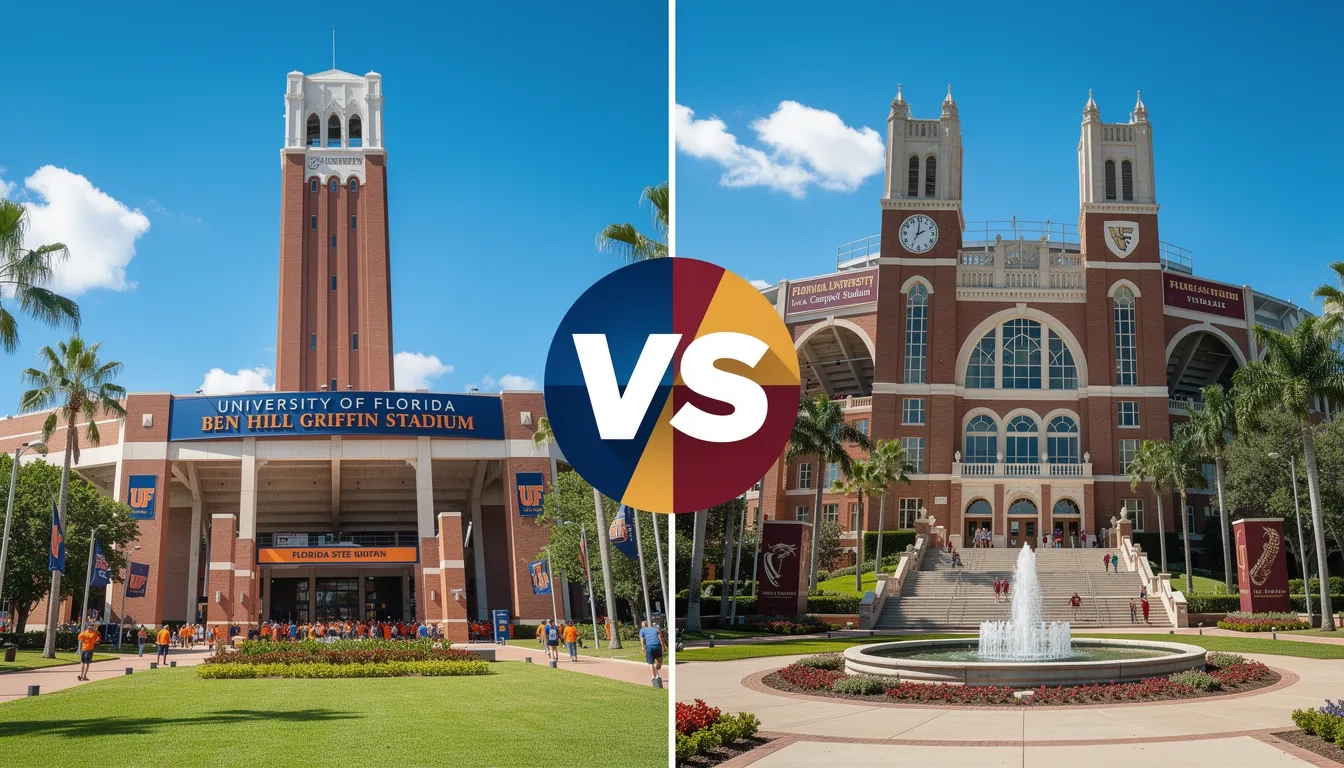
Here's a fact that almost nobody knows: the University of Florida and Florida State University were literally born from the same institution. The Buckman Act of 1905 split Florida State College into two schools — one for men in Gainesville, one for women in Tallahassee. So the Gators and the Seminoles share DNA. Which makes the rivalry feel more like a family feud than anything else.
If you're trying to decide between the two, or just want to understand what actually separates them beyond the jersey colors, you're in the right place. I'll break down academics, cost, programs, campus culture, and yes — the football series — so you can walk away with a real picture.
Rankings and Academic Standing
UF sits in a different tier by most national measures. In the 2025 U.S. News & World Report rankings, the University of Florida placed 7th among all public universities in the nation — a position it has held for seven consecutive years. FSU ranked 23rd among publics. On Forbes' most recent list of top public universities, UF placed 4th and FSU 22nd.
That gap matters most in graduate school admissions and highly competitive hiring pipelines, where name recognition and research output get weighted heavily. It's not a knock on FSU — 23rd among all public universities in the United States is genuinely excellent. But if you're gunning for a PhD program at MIT or a job at McKinsey out of undergrad, the UF brand opens doors a little wider.
One area where FSU punches above its weight: first-year student experience. The 2025 U.S. News rankings included a new "First Year Experiences" category, and FSU ranked 7th nationally among public universities — first within Florida's entire State University System. For students worried about feeling lost at a big school, that's meaningful.
Admissions: How Hard Is It to Get In?
| Metric | UF | FSU |
|---|---|---|
| Acceptance Rate | ~23% | ~25–29% |
| SAT Median (Math) | 700 | 640 |
| ACT Composite Median | 31 | 29 |
| Student-to-Faculty Ratio | 17:1 | 21:1 |
UF is the more selective school by every standard measure. The median UF admit scores between 1350–1490 on the SAT; FSU's middle 50% runs 1250–1380. The gap is real, though not enormous. Strong students who get into both schools genuinely face a meaningful choice.
One counter-intuitive note: FSU's acceptance rate looks similar, but the pool applying to FSU skews slightly less competitive overall. So FSU may feel "easier" to get into, but that perception depends heavily on your own academic profile.
Tuition and Financial Value
In-state tuition at both schools is remarkably affordable by national standards. You're paying around $4,500 a year either way — well below the national average for public flagships.
The story diverges for out-of-state students. UF charges about $25,694; FSU charges $19,084. That's a $6,610 annual difference, or roughly $26,440 over four years. For families paying out of pocket, FSU offers meaningfully more value if you're coming from outside Florida.
| Tuition Type | UF | FSU |
|---|---|---|
| In-State (Undergraduate) | $4,477 | $4,640 |
| Out-of-State (Undergraduate) | $25,694 | $19,084 |
| In-State (Graduate) | $10,770 | $9,684 |
| Out-of-State (Graduate) | $27,335 | $24,116 |
Both schools offer Bright Futures scholarships for Florida residents who qualify — which can slash costs dramatically. If you're Florida-born and Bright Futures-eligible, the price difference nearly vanishes, and the decision shifts entirely to fit.
Academic Programs: Where Each School Shines
UF's strongest programs cluster in STEM, business, and health sciences. The Warrington College of Business ranks 13th nationally in accounting (per 2025 U.S. News), and UF's veterinary medicine program sits at 5th in the country. Education rounds it out at 6th. UF produced $1.25 billion in research expenditure in recent reporting — a 15.1% jump year over year — and ranks 2nd nationally for producing Fulbright U.S. Scholars (12 scholars in 2024–2025, according to UF's own reporting).
FSU owns different territory. The school consistently leads Florida in National Science Foundation funding, particularly in the physical sciences. FSU's faculty has included six Nobel Laureates — more than UF's two (Robert H. Grubbs and Hamilton O. Smith). FSU also runs one of the country's premier music conservatories and has deep strengths in law, criminology, political science, and the performing arts.
Here's a simple decision framework:
- Pursuing engineering, business, veterinary medicine, or health sciences? UF is the stronger fit.
- Studying the arts, music performance, criminology, political science, or physical sciences research? FSU competes at a higher level than its overall ranking suggests.
- Undecided? UF offers 103 bachelor's programs; FSU offers 282 total degree programs across all levels, giving you more room to pivot.
Campus Life and Size
The campuses feel nothing alike. UF's main campus spans 2,000 acres in Gainesville — larger than many small towns. FSU's is 487 acres in Tallahassee. Walking between classes at UF can mean a 20-minute haul; FSU is more walkable on a day-to-day basis.
Student body size follows the same pattern: UF enrolls roughly 53,000 students, FSU about 44,000. Neither is "small," but FSU's tighter footprint and lower enrollment create a campus that many students describe as feeling more cohesive (not that Gainesville students are complaining — it's a college town in the truest sense, built around the university).
The student-to-faculty ratio gap is real: 17:1 at UF versus 21:1 at FSU. In practice, this matters more at the upper-division and graduate levels than in introductory lectures, where both schools pack hundreds of students into auditoriums. But it does mean UF students on average get slightly more faculty access when it counts.
"FSU ranked 7th nationally for First Year Experiences among public universities — a sign that the school invests heavily in making a big campus feel smaller for incoming students."
Both cities have their own distinct energy. Gainesville has a well-earned reputation as one of America's great college towns, with a live music scene, dense off-campus housing infrastructure, and a culture almost entirely shaped by the university. Tallahassee is Florida's state capital, which means FSU students have unusually direct access to government internships, policy work, and state-level political networking.
The Rivalry: More Than Just Football
The Florida–Florida State series has been played 69 times. The Gators lead 39–28–2 overall. In the most recent meeting (November 30, 2024), Florida won 31–11.
But the series has been viciously competitive across most of its history. Between 1990 and 2000, both teams were ranked in the Top 10 in every single matchup. The 1996 game featured the #1 and #2 teams in the country facing off — one of the more electric regular-season games in college football history.
Athletically, the two programs are closer than the overall record suggests:
- Heisman Trophy winners: UF 3, FSU 3
- NFL first-round draft picks: UF 56, FSU 47
- NFL Hall of Famers: UF 2, FSU 5
Both schools have produced elite professional talent across multiple generations. The rivalry extends into basketball, baseball, and soccer — but football is the one that stops traffic in north Florida every November.
The cultural weight of this rivalry is hard to overstate. Families split down the middle. Bumper stickers stay up year-round. The game typically ranks among ESPN's highest-rated regular-season telecasts. For prospective students, knowing which sideline you'll spend four years on is a legitimate factor in the decision.
Career Outcomes After Graduation
UF graduates reported a median starting salary of $72,340 for the 2024–25 class, with 72% of surveyed graduates in full-time employment. The BestColleges comparison noted a roughly $7,000 gap in median first-year salaries favoring UF graduates — which tracks with UF's stronger placement in fields like engineering, finance, and health sciences that skew higher.
FSU's career center runs its own Graduating Senior Survey with 90%+ response rates, and its numbers are strong — particularly for graduates entering government, law, and the public sector (the Tallahassee connection helps there).
The honest framing: both schools produce successful graduates at scale. The salary gap reflects program mix more than raw quality. An FSU music performance graduate and a UF chemical engineering graduate are being compared in that $7,000 number, which makes institutional comparison a bit slippery. Major matters as much as school name in Florida's labor market.
UF's $16.91 billion economic impact on the state (by the university's own estimates) reflects how deeply embedded its graduates are in Florida's economy — particularly in healthcare, agriculture, and technology.
Bottom Line
- Go to UF if you want the stronger STEM/business programs, higher national rankings, and a campus-town experience that's hard to beat. The 17:1 faculty ratio and $1.25B research engine matter if you're heading toward graduate school or competitive national employers.
- Go to FSU if you're studying the arts, physical sciences, law, criminology, or political science — or if you're an out-of-state student watching your budget ($6,600/year cheaper). The first-year experience ranking is a real signal that the school invests in undergrads.
- For Florida residents on Bright Futures, the financial difference nearly disappears. Make the decision on program fit, location, and where you actually see yourself thriving.
- The rivalry is real, the stakes are personal, and both schools will give you a legitimate education. Pick the one where you'll show up on day one and feel like you belong.
Frequently Asked Questions
Is UF harder to get into than FSU?
Yes, by a meaningful margin. UF's acceptance rate sits around 23% with a median SAT score around 700 in math; FSU accepts roughly 25–29% of applicants with a median math score near 640. Both schools are selective for Florida public universities, but UF requires a notably stronger academic profile.
Which school is cheaper for out-of-state students?
FSU is significantly cheaper for out-of-state students. Annual out-of-state tuition runs about $19,084 at FSU versus $25,694 at UF — a gap of over $6,600 per year. For in-state students, the difference is under $200 annually, which makes it essentially a wash.
Is FSU actually a good school, or is it just easier to get into than UF?
FSU is a genuinely strong research university. It leads all Florida universities in NSF physical sciences funding, has had six Nobel laureates on faculty, and ranks in the national top 25 among public schools. The reputation gap with UF is real but narrower than popular perception suggests — especially in FSU's signature programs like criminology, music, and political science.
Which school has the better football program?
Historically, Florida holds a 39–28–2 series advantage. But both programs have produced three Heisman Trophy winners and dozens of NFL first-round picks. Florida won the most recent game 31–11 in November 2024. Over the past decade, the series has been competitive, with momentum shifting frequently.
Which school is better for pre-med students?
UF has the edge here. Its health science infrastructure, veterinary medicine program (ranked 5th nationally), research output, and proximity to UF Health Shands — one of the largest academic medical centers in the Southeast — make it the stronger pre-med environment. FSU does have its own medical school, which gives undergrads some access to clinical pathways.
Can a Florida resident attend both schools for nearly the same price?
Essentially, yes. In-state tuition is $4,477 at UF and $4,640 at FSU — a difference of $163 per year. For Bright Futures scholarship recipients, both schools can end up nearly free. Cost should not be the deciding factor for Florida residents choosing between the two.
Sources
- Florida vs. Florida State: How Do They Compare? | BestColleges
- Florida's Universities Remain Top-Rated in the 2025 U.S. News Rankings — State University System of Florida
- University of Florida vs. Florida State University 2026 | CampusReel
- University of Florida ranks second for Fulbright Top Producing Institutions | UF News
- FSU Highlights & Rankings | Florida State University
- 2023–2024 Student Outcomes — UF Career Connections Center