WashU vs Vanderbilt: A Real Mid-Size Research Comparison
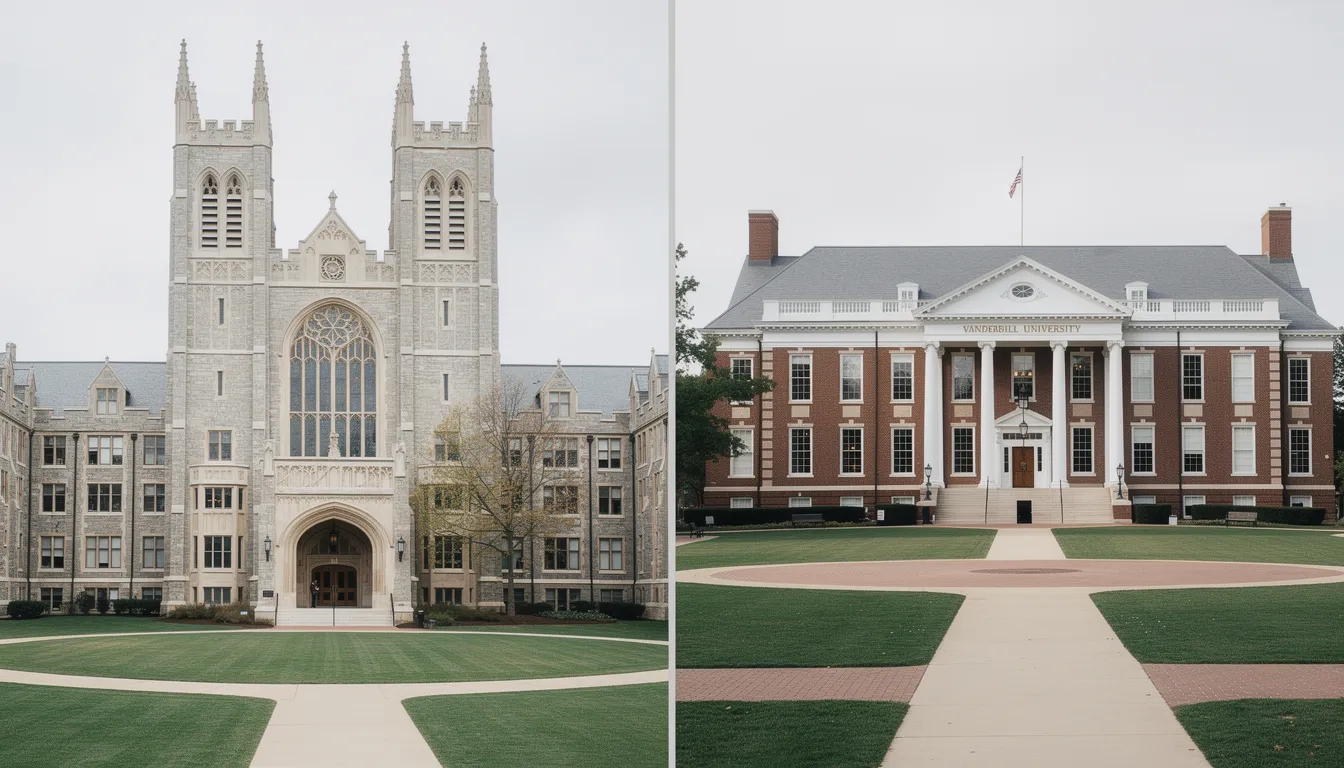
Most college comparison sites will show you a table where WashU and Vanderbilt look nearly identical. Similar rankings. Similar class sizes. Similar tuition. Close enough that people sometimes shrug and pick based on which city sounds more fun.
That's the wrong way to do this.
These two schools diverge in ways that matter enormously depending on what you're actually looking for—from where their research dollars concentrate to what kind of student genuinely thrives there. Here's the breakdown that the rankings skip.
The Numbers Side by Side
Start with the basics, because a few of these surprises are worth sitting with.
Vanderbilt is meaningfully more selective than WashU by a real margin. Its acceptance rate is 10.3% versus WashU's 16.3%. That gap is larger than the difference between WashU and some schools typically considered a full tier below—so it's not a minor footnote.
| Metric | WashU | Vanderbilt |
|---|---|---|
| Acceptance rate | 16.3% | 10.3% |
| Average SAT | 1469 | 1498 |
| Average ACT | 33 | 34 |
| Total enrollment | ~16,500 | ~13,456 |
| Student-faculty ratio | 7:1 | 8:1 |
| Endowment | $12.0B | $10.85B |
| Graduation rate | 93% | 92% |
WashU carries the larger endowment in absolute terms. With fewer students, though, Vanderbilt's endowment-per-student flips the comparison: roughly $807,000 per student at Vanderbilt versus $727,000 at WashU. That extra per-student resource shows up in residential programming and faculty mentorship in ways that are hard to quantify but real.
Both are genuinely mid-size—no 40,000-student football culture here. At 7:1 and 8:1 faculty ratios respectively, these are places where a freshman can actually get a professor's attention.
Research Firepower
This is where the comparison gets interesting—and where WashU pulls off something that surprises most people.
WashU's medical school ranks second in the country for NIH funding, trailing only UCSF. In fiscal year 2024, WashU Medicine pulled in $576 million in NIH grants alone. The university's total research funding crossed $1 billion for the first time in its history—up from $532 million a decade earlier. That trajectory is steep.
Vanderbilt is not far behind. Its medical school ranked fifth nationally in NIH funding in FY2024, securing $586 million in direct and indirect support. Three of its departments topped national rankings that year: Medicine ($277 million), Pediatrics ($80 million), and Emergency Medicine, which claimed the #1 slot nationally with $21.5 million in FY2025 grants.
When two schools rank #2 and #5 in NIH funding nationally, the gap between them is more about research focus than research quality.
The real divergence is total institutional output. WashU's research enterprise exceeds $1 billion annually when you include its Danforth campus alongside the medical school—one of roughly a dozen U.S. universities that can make that claim. WashU's research has also spawned 40 startups that collectively raised over $425 million in investment capital and employ roughly 1,100 people. The university's research faculty grew 30% between 2017 and 2023.
For undergraduates, this activity creates real opportunity. WashU runs funded programs specifically built to plug undergrads into ongoing faculty projects. Vanderbilt offers similar access, particularly in STEM and medical research, but WashU's institutional push toward undergraduate research involvement is more systematic.
Where Each School Actually Dominates
Rankings tell you where schools are strong. They rarely tell you how strong, or in what way.
WashU's standout programs:
- Olin Business School ranks among the top 15 undergraduate business programs in the country, with a well-regarded MBA alongside it
- Brown School of Social Work is a perennial #1 in U.S. News rankings for graduate social work
- WashU School of Law sits in the top 20 nationally
- Biology and Chemistry research output both rank in the top 25 globally, according to EduRank's 2026 data, with over 155,000 publications and 9.3 million citations in Biology alone
Vanderbilt's standout programs:
- Peabody College is a top-5 education school, consistently, and arguably the most prestigious college-within-a-university for education and human development
- Blair School of Music is one of the strongest undergraduate music programs at any major research university in the country
- Nursing, with direct clinical ties to Vanderbilt University Medical Center
- Biomedical and electrical engineering programs with strong research funding
The practical implication: if you want business, law, or social sciences, WashU has more institutional infrastructure. If you want education, nursing, or music, Vanderbilt is operating in a different tier. These are genuine strengths, not marginal differences.
Campus Life and City
Nashville versus St. Louis is a real lifestyle choice, not just a geography trivia question.
Nashville in 2026 is one of the country's fastest-growing cities, with a working music industry, a serious food scene (not just honky-tonk bars), and a culture that leans outward. Vanderbilt's location in the middle of all that means internships, concerts, and weekend plans feel abundant. The campus is officially a 300-acre protected urban arboretum—so it somehow manages to feel like a green refuge while sitting inside a buzzing city.
St. Louis gets undersold. Forest Park, which sits adjacent to WashU's campus, is larger than Central Park and contains three free world-class museums (the Saint Louis Art Museum, the Missouri History Museum, and the Saint Louis Science Center). The city's cost of living is lower than Nashville's, which matters on a student budget. WashU's campus itself ranks among the most architecturally beautiful in the country—compact, walkable, and cohesive.
Greek life is heavier at Vanderbilt, with roughly 40% of students participating versus about 30% at WashU. Vanderbilt also runs the Ingram Commons, a residential program where all first-years live in faculty-led houses organized around shared intellectual themes. It's unusual for a university this size and consistently gets credit for building cross-major friendships that persist through graduation.
Costs and Financial Aid
Neither school is cheap at sticker price. But what students actually pay diverges.
WashU's average net price (after grants and aid) is approximately $22,440 per year. Vanderbilt's average net price is $26,689. Over four years, that gap compounds to roughly $17,000—real money.
Both schools have no-loan policies for eligible students, replacing loan components with grants. WashU formalized this for qualifying families in 2023. Vanderbilt has a similar structure for families below certain income thresholds.
The wrinkle: since Vanderbilt is more selective, many students who apply to both don't get admitted to Vanderbilt—so the financial comparison only matters when you actually have two offers in hand. If that's your situation, compare the award letters directly and don't rely on these averages.
Career Outcomes After Graduation
Both schools produce well-employed graduates. The 10-year median earnings gap between them is roughly $300 per year in Vanderbilt's favor—a number so small it's statistical noise given individual variation.
Where they genuinely differ is the type of outcome. WashU historically sends a high share of students into medicine, law, and finance. The pre-med pipeline through WashU Medicine is well-worn, and Olin Business School's employer relationships funnel students toward consulting and banking. The startup commercialization engine also creates a small but real path into biotech.
Vanderbilt's alumni network is geographically broader, reflecting Nashville's growing national profile. Peabody graduates are disproportionately represented in education leadership and policy. Blair alumni end up at major orchestras, in music licensing, and in arts administration. The university's Tennessee-to-everywhere reach has expanded considerably as Nashville's economy has grown.
The honest read: neither school will fail you on employment. The difference is which doors each one opens most easily, not whether doors exist at all.
How to Actually Choose
Here's a clean decision framework.
Choose WashU if:
- You're pursuing pre-med, business, law, or social sciences and want top-tier infrastructure in those areas
- You want funded undergraduate research access from day one
- You prefer a slightly quieter city with lower cost of living
- You're comfortable with a school whose research reputation exceeds its casual brand recognition
Choose Vanderbilt if:
- You want to study education (Peabody), nursing, or music (Blair)—and you want the best version of those programs
- Nashville's energy and industry connections fit your career interests
- You're a strong enough applicant that the lower acceptance rate isn't a barrier
- The Ingram Commons residential model and more active Greek life sound like your social environment
I'll say plainly: the assumption that Vanderbilt is simply more prestigious because of a lower acceptance rate is worth questioning. WashU's research output—#2 in NIH funding, over $1 billion in annual research spending—is formidable by any measure. In academic and scientific circles, WashU's reputation is on par with or ahead of Vanderbilt. The prestige conversation depends heavily on who you're talking to and what field you're entering.
Bottom Line
- WashU and Vanderbilt are both elite mid-size research universities. The choice between them hinges on academic program fit, city preference, and financial aid—not on one school being dramatically superior.
- WashU's research infrastructure is the underappreciated story: #2 in NIH funding nationally, over $1 billion in total annual research spending, and a well-built pipeline for undergraduates who want to participate.
- Vanderbilt wins on selectivity, Nashville's pull, and specific programs—particularly Peabody (education), Blair (music), and nursing.
- Get both financial aid award letters before deciding. The ~$4,200 average net price difference is real money over four years.
- Visit both campuses if you can. The feel of each place does more deciding than any table.
Frequently Asked Questions
Is WashU or Vanderbilt harder to get into?
Vanderbilt is noticeably more selective. Its acceptance rate is 10.3%, compared to WashU's 16.3%. Average test scores are close—SAT 1498 vs 1469, ACT 34 vs 33—but Vanderbilt's overall selectivity makes it the harder admit for most applicants.
Which school is better for pre-med students?
WashU makes a strong case. Its medical school is second in the country for NIH funding, and undergraduates have structured access to research labs through funded programs. The pre-med pipeline is well-established, with many students continuing into WashU's own medical school or other top programs. Vanderbilt's VUMC is a powerhouse clinical institution, but WashU's undergraduate research infrastructure is more explicitly designed to bring students in early.
Does WashU have a strong business school?
Yes—and this gets overlooked. Olin Business School at WashU consistently ranks among the top 15 undergraduate business programs in the country. Many students who would consider Wharton or Ross also seriously consider Olin. It's one of WashU's most concrete differentiators from Vanderbilt, which doesn't have a dedicated undergraduate business school.
Is Nashville or St. Louis better for internships?
Nashville has grown into a serious business hub for healthcare, tech, and media. Vanderbilt's location makes local internships accessible. St. Louis has a strong healthcare and biotech corridor—partly fed by WashU's own research enterprise—but Nashville's overall economic growth in recent years gives it a broader internship ecosystem for students whose interests span multiple industries.
What's the myth about WashU being a safety school for Ivy rejections?
This reputation, earned when WashU aggressively recruited students who had declined Ivy offers in the early 2000s, no longer reflects its actual applicant pool or selectivity. Its acceptance rate has dropped sharply over two decades. In research output and peer assessment, WashU now competes directly with schools that have stronger casual brand recognition. It is a reach for most applicants, full stop.
Which school has better financial aid?
On average, WashU's net price ($22,440/year) runs lower than Vanderbilt's ($26,689/year). Both schools offer no-loan aid packages for eligible students. But financial aid is individualized—the only reliable comparison is your actual award letters from both schools placed side by side.
Sources
- WashU research funding exceeds $1 billion for first time – The Source, WashU
- WashU Medicine rises to No. 2 in nation in NIH research funding
- Vanderbilt University School of Medicine fifth in the nation in NIH research funding
- Vanderbilt vs WashU: Which is the better choice? – CollegeVine
- Vanderbilt University vs. WUSTL 2026 – CampusReel